
PART >> 2 My dad threw my grandmother’s savings book into her grave and said it was worthless. The next day I went to the bank, and the teller turned pale before calling the police.

The morning paper lay unread on the wooden table, the bold headline fading beneath the harsh glare of the midday sun. Across the city, the air carried the scent of autumn and roasted corn, a familiar rhythm returning to streets that had spent decades wrapped in heavy silence.
In the small office of the foundation, the sound of a mechanical stamping machine clicked rhythmically—a steady, methodical beat that signaled order being restored to chaos. Rosa stood by the filing cabinets, her fingers tracing the metal tabs of a new drawer labeled Active Cases. Every folder placed inside was a life reclaimed from the dark.
The door chimed, and Camila stepped inside, shaking a light drizzle from her jacket. She carried two paper cups of coffee, setting one on the desk beside Mariana’s stack of legal briefs.
“How many today?” Camila asked, pulling a red pencil from her hair.
“Fourteen new tips from the northern district,” Mariana replied, not looking up from the manifest. “Most are dead ends. Two look promising.”
Camila smiled faintly, leaning against the edge of the desk. “We used to count the days by how many secrets we had to keep. Now we count them by how many we tear open.”
“And we’re just getting started,” Mariana said, finally looking up.
The resemblance between them was undeniable—not just in the shape of their eyes or the way their fingers wrapped around the ceramic mugs, but in the quiet, unyielding set of their jaws. They were women forged from the same stubborn history, refusing to let the shadows dictate their future.
That evening, the sisters walked together toward the bus stop, the city lights flickering on against the gathering dusk. Rosa was waiting for them at the apartment, having already set the table with sweet bread and hot chocolate.
As they turned the corner of Fresno and Naranjo, Mariana glanced instinctively at the old brick wall where her journey had begun—the place where Victor had tried to lock away her past, her name, and her family. The rusty bars of the bathroom window had long since been repaired by the new tenants, the walls painted a cheerful, unassuming yellow.
She stopped for a moment, letting Camila walk a few paces ahead.
“Coming?” Camila called out, turning with a soft, questioning smile.
Mariana looked down at her hands, then up at the open sky, where the stars were beginning to break through the violet haze of twilight. For thirty-seven years, she had carried the weight of an invisible life. But tonight, the air felt light. The ground beneath her feet felt solid.
“Yeah,” Mariana said, her voice steady and clear as she hurried to catch up. “I’m right behind you.”
Months bled into years, and the foundation expanded into a national sanctuary. What began as a cramped office with a single stamping machine grew into a sprawling network of legal advocates, forensic genealogists, and social workers dedicated to unmasking illegal adoption rings and returning stolen identities to their rightful owners.
The trials of Victor’s associates unraveled like dominoes. Patricia, hoping for a reduced sentence, turned state’s evidence, opening the floodgates to a web of corruption that stretched from local clinics all the way to high-ranking municipal courts. One by one, the architects of stolen childhoods faced justice.
Yet, for Mariana, the true victory wasn’t found in courtrooms or headlines. It was found in the quiet, ordinary moments that had been stolen from them.
Sundays became sacred. The small apartment on Naranjo Street, once heavy with ghosts and fear, now echoed with laughter, clinking silverware, and the rich aroma of Rosa’s cooking. Teresa, Camila’s adoptive mother, joined them often, bridging the gap between two families that fate had torn apart and love had stitched back together. At first, the silences between Teresa and Rosa were fragile, built on the delicate hesitation of two women who had both loved the same child in different ways. But time dissolved the barriers. They learned to share recipes, memories, and the hard-earned grace of forgiveness.
Camila continued teaching third grade, though now her classroom walls were decorated with colorful maps and alphabet charts instead of hiding shadows. Sometimes, students would stay after class just to talk, drawn to her fierce, protective kindness—a trait she didn’t know she shared with an entire lineage of women who refused to break.
Mariana took on the field investigations, traveling to distant towns and dusty archives where forgotten records slept under layers of dust. She became the voice for those who had lost theirs, walking into terrifying rooms with the steady, unshakeable calm of someone who had already survived the worst the dark had to offer.
One crisp spring afternoon, years after the vault had been opened, Mariana stood outside the cemetery gates. The old metal hinges no longer groaned; Don Eusebio had oiled them before retiring, leaving his keys in trustworthy hands.
She walked down the narrow gravel path, her boots crunching softly against the earth, until she reached niche 307.
The new plaque caught the afternoon light, shining bright and clean against the weathered stone. Here Guadalupe Salazar kept the truth when no one wanted to hear it.
Mariana placed a single yellow rose on the cold marble, tracing the engraved letters with her fingertips.
“We did it, Grandma,” she whispered to the wind. “The house is full. The books are open. And nobody is hiding anymore.”
Footsteps echoed softly behind her. She didn’t need to turn around to know who it was. Rosa and Camila stood side by side, holding hands, their silhouettes framed by the golden glow of the sinking sun.
Mariana stood up, turned toward her family, and smiled—not with the bitter resilience of a survivor, but with the quiet, unbroken joy of someone who had finally come home.
CLICK HERE TO READ PART >> 3
You may also like
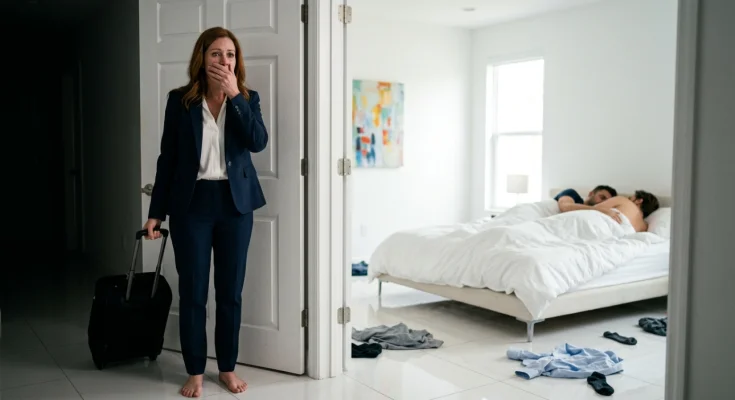
At around 11 A.M., Clara arrived home unexpectedly after spending four months away on business
Around eleven that morning, Clara returned home after spending four months away on a business trip. She deliberately…
PART 2: At around 11 A.M., Clara arrived home unexpectedly after spending four months away on business
The hallway seemed impossibly longer than it had only moments before. Clara refused to look back because the…
PART 3 : At around 11 A.M., Clara arrived home unexpectedly after spending four months away on business
The city hummed quietly as Clara sat alone in her parked car three blocks from the apartment. The…