
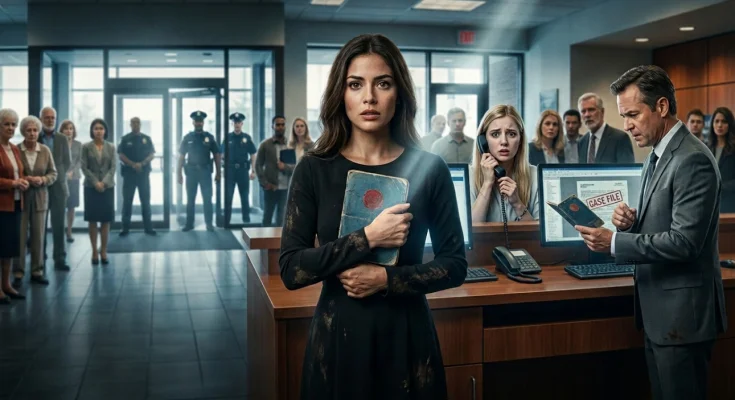
PART >> 3 My dad threw my grandmother’s savings book into her grave and said it was worthless. The next day I went to the bank, and the teller turned pale before calling the police.
The autumn wind carried the sharp scent of damp earth and woodsmoke as Mariana, Rosa, and Camila walked down the gravel path of the cemetery. The yellow rose Mariana had left on niche 307 caught the fading light, its petals glowing like a small spark against the grey stone.
For a long time, none of them spoke. The silence wasn’t heavy anymore; it was the quiet of a shared anchor.
“Teresa called this morning,” Camila said softly, breaking the stillness as they reached the iron gates. “She’s hosting Sunday dinner at her place this week. She wants to try making your mother’s mole recipe, Rosa.”
Rosa stopped, a flicker of genuine surprise crossing her face, followed by a warm, hesitant smile. “My mole? She’ll need to roast the chilies longer than she thinks. I’ll go over early and help her.”
Mariana watched them, a profound sense of wonder washing over her. Two women who could easily have been enemies, bound together by the theft of a child, were now sharing kitchen tips. It was a miracle forged in the aftermath of cruelty—a testament to the fact that love, unlike greed, multiplied when shared.
Yet, even as peace settled over their daily lives, the foundation’s work was far from finished.
The files recovered from Victor’s safe and Arthur Vance’s estate were vast, containing hundreds of names, encrypted ledger codes, and references to regional hubs that had operated across state lines. The network was not merely local; it was an underground river of stolen identities that had flowed uninterrupted for decades.
The next morning, the office was already buzzing when Mariana arrived. Agent Lucía Maldonado was leaning against the edge of the desk, reviewing a digital map spread across the computer screen. Dark circles shadowed Lucía’s eyes—the enduring toll of confronting her own father’s legacy in a courtroom that still echoed with his defense attorneys’ final, desperate maneuvers.
“Morning,” Lucía said without looking up, tapping a red marker against a cluster of pins near the northern border. “We decrypted the financial logs from the Santa Irene clinic accounts. The money didn’t just vanish into offshore shell companies. A significant portion was funneled into a real estate trust managed under an alias.”
Mariana hung her jacket on the rack and stepped closer, her eyes scanning the data. “Whose alias?”
“A name we haven’t seen in the primary indictments,” Lucía replied, turning her laptop toward her. “A woman named Beatriz Soto. According to property records, she owns a sprawling compound three hours north, near the state line. For thirty years, it operated as a private boarding school. But local tax exemptions were granted under a very specific humanitarian clause—one reserved for state wards and unassigned minors.”
Mariana’s breath caught. “An orphanage.”
“Not an orphanage,” Lucía corrected grimly. “A clearinghouse. Children brought in from rural clinics under false death certificates were laundered through that facility, given new names, and funneled into adoptive networks before anyone could trace the paper trail. And based on the registry dates, it’s still active.”
The office fell silent. The steady, rhythmic click of the mechanical stamping machine from the back room suddenly felt like a ticking clock.
“How many children?” Mariana asked, her voice dropping to a harsh whisper.
“Hundreds, over a span of thirty years,” Lucía said quietly. “And if our analysts are right, there are kids—now adults, some with families of their own—walking around right now who have no idea who they actually are.”
Mariana looked down at her desk, her gaze falling upon the worn spine of her grandmother’s notebook. She traced the faded blue ink of her grandmother’s final warning: When you find your sister, don’t charge alone anymore.
She wasn’t alone anymore. She had Rosa. She had Camila. She had Lucía, and a network of advocates, and a family built from the fragments of the past.
“When do we leave?” Mariana asked.
Lucía closed her laptop with a definitive snap. “Dawn tomorrow. We’re coordinating with federal marshals. But Mariana… this isn’t just a raid. This is going to blow the remaining doors off the entire syndicate. Once we step foot on that property, there’s no turning back.”
Mariana looked out the window. Across the street, the sun was breaking through the morning mist, illuminating the bustling sidewalks, the vendor carts, and the ordinary lives of people who had no idea how close they were to the light.
“Good,” Mariana said, her fingers tightening around the edge of the desk. “We’ve spent thirty years in the dark. It’s time to let the sun in.”
CLICK HERE TO READ PART >> 4
You may also like
At around 11 A.M., Clara arrived home unexpectedly after spending four months away on business
Around eleven that morning, Clara returned home after spending four months away on a business trip. She deliberately…
PART 2: At around 11 A.M., Clara arrived home unexpectedly after spending four months away on business
The hallway seemed impossibly longer than it had only moments before. Clara refused to look back because the…
PART 3 : At around 11 A.M., Clara arrived home unexpectedly after spending four months away on business
The city hummed quietly as Clara sat alone in her parked car three blocks from the apartment. The…
One Comment on “PART >> 3 My dad threw my grandmother’s savings book into her grave and said it was worthless. The next day I went to the bank, and the teller turned pale before calling the police.”