
Part 2 — the Christmas Envelopes That Silenced the Whole Table
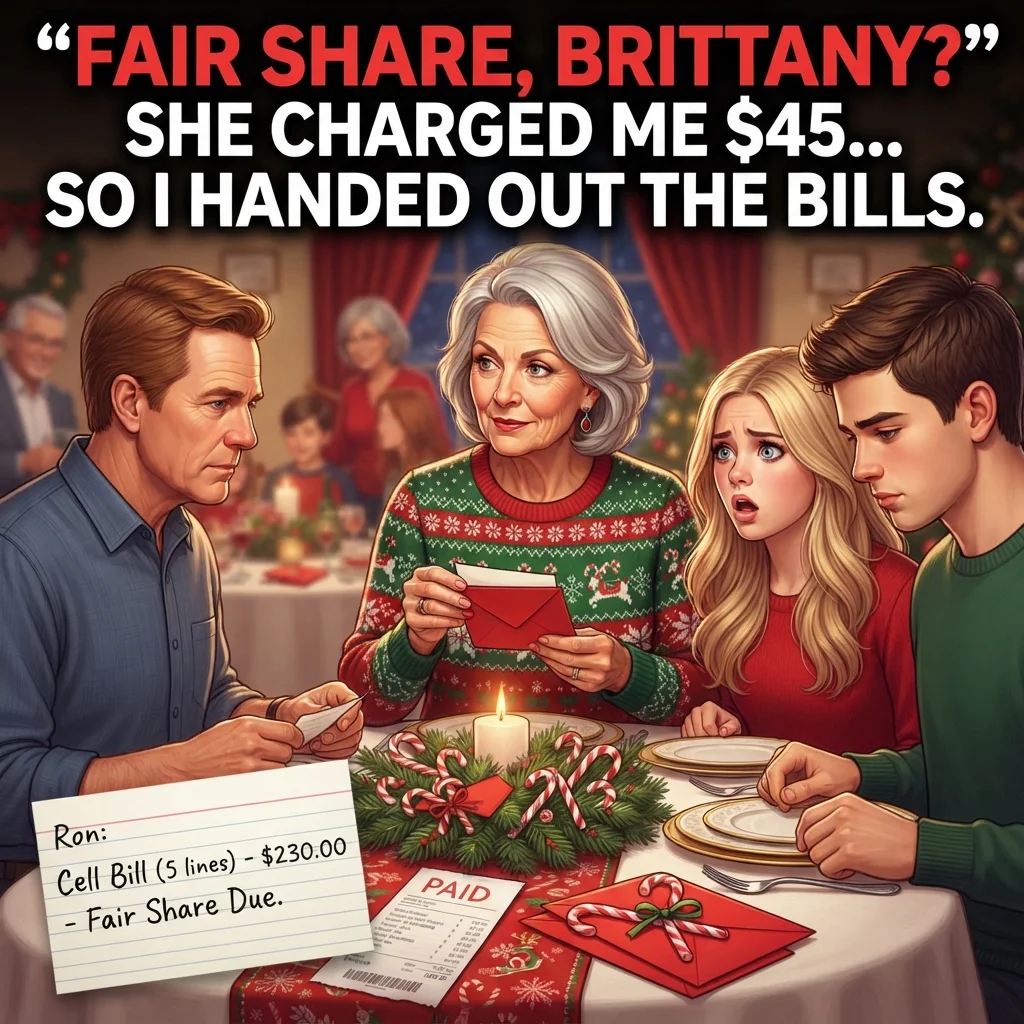
Ron Schaefer was the first one to open his red envelope.
I hadn’t planned it that way.
But Ron had always been the kind of man who couldn’t leave a wrapped present alone, even one that was barely bigger than a grocery receipt.
He pulled out the folded paper, adjusted his glasses, and read the first line out loud.
“Dear Ron, beginning January first, your portion of the family phone plan will be forty-two dollars and fifty cents per month.”
He stopped.
The whole table went quiet.
Then he laughed.
“Well, what’s this supposed to be, Georgia? Some kind of Christmas joke?”
I smiled and reached for my coffee.
“No joke, Ron. Just everybody paying their fair share.”
Brittany’s fork hit her plate.
It wasn’t a loud sound.
But in that dining room, it might as well have been a gunshot.
“What did you just say?” she asked.
I looked right at her.
“I said what you said at Thanksgiving, honey. Everybody pays their fair share.”
Kyle slowly lowered his glass.
Debbie was already opening her envelope.
“Forty-two fifty?” she whispered.
Then she looked at her husband.
“Ron, why does mine say forty-two fifty too?”
Ron turned toward Kyle.
“Son, I thought you were covering the phones.”
Kyle’s face went pale.
And that was when Brittany realized something was wrong.
“Wait,” she said, looking between the three of them. “What phones?”
I took a small sip of coffee.
“The phones you’ve all been using for years.”
Brittany frowned.
“Kyle pays our phone bill.”
“No, sweetheart,” I said gently. “Kyle doesn’t.”
She turned toward her husband.
“Kyle?”
He didn’t answer.
“Kyle, what is your mother talking about?”
My son stared at the table.
I recognized that look.
I’d seen it when he was nine years old and accidentally broke his daddy’s fishing rod.
He’d hoped if he stayed quiet long enough, the problem would somehow disappear.
But he was forty-two now.
And silence wasn’t going to fix this one.
“Mom’s been paying the phones,” he finally muttered.
Brittany blinked.
“What?”
“Since I got laid off.”
“That was five years ago!”
“I know.”
“And you told me everything was included through your work!”
Kyle closed his eyes.
“I know.”
Ron put his paper down.
“Hold on. Are you saying Georgia has been paying for my phone?”
“Yes,” Kyle answered.
“And mine?” Debbie asked.
“Yes.”
Brittany looked at me.
For the first time since I’d known her, she didn’t seem to have a prepared response.
I almost felt sorry for her.
Almost.
Then she said something that reminded me exactly why I’d brought those envelopes.
“Well, if you’ve been paying all this time, why make an issue of it now?”
I set my coffee cup down.
Very carefully.
“That’s a good question, Brittany.”
She folded her arms.
“Then answer it.”
I reached into my purse.
And pulled out a little white index card.
The same one she’d placed beside my Thanksgiving dinner.
I laid it on the table.
Right between the cranberry sauce and the butter dish.
“Because you taught me something at Thanksgiving.”
Nobody moved.
I pointed to her handwriting.
“Turkey, sides, dessert. Forty-five dollars.”
Debbie leaned forward.
“What’s that?”
“That’s what your daughter charged me to eat Thanksgiving dinner.”
Ron frowned.
“She charged you?”
“Forty-five dollars,” I answered. “For a meal I helped cook.”
Debbie slowly turned toward Brittany.
“Brittany Elaine.”
Her daughter stiffened.
“Mom, it wasn’t like that.”
“Then what was it like?”
Brittany looked around the table.
“Everyone was supposed to contribute.”
Ron raised his eyebrows.
“We didn’t pay anything.”
“You helped clean up!”
Debbie stared at her daughter.
“I rinsed three plates and put away the rolls.”
I couldn’t help it.
I laughed.
Just once.
It slipped out before I could stop it.
Brittany glared at me.
“You think this is funny?”
“No, honey. I think it’s educational.”
Kyle rubbed his forehead.
“Mom, please.”
I turned to him.
“Please what, Kyle?”
He swallowed.
“Can we just have Christmas?”
I looked at my boy.
The little fellow who used to run into my kitchen with scraped knees.
The teenager whose baseball uniform I’d washed at midnight.
The grown man who’d called me crying when he lost his job.
And I realized something painful.
For five years, I’d been helping him stand.
Somewhere along the way, he’d gotten comfortable letting me carry him.
“That’s exactly what I’m trying to do,” I told him. “Have Christmas. Without pretending.”
Nobody said anything.
Then Ron cleared his throat.
“Georgia, if I’d known you were paying for my phone, I’d have taken care of it myself.”
“I believe you would have, Ron.”
And I meant that.
Ron had his faults.
Lord knows the man could talk about fishing until the paint peeled off the walls.
But he’d never once directly asked me to pay his bills.
He’d been told Kyle was handling things.
Just like Brittany had.
That was the part I hadn’t expected to hurt so much.
I’d thought I was exposing Brittany’s unfairness.
Instead, I was exposing my own son’s dishonesty.
Debbie opened her envelope again.
“Georgia, how long have you been paying?”
“Yours and Ron’s? About three years.”
“And Kyle and Brittany?”
“Five.”
She looked over at Kyle.
“Five years?”
Kyle nodded without raising his head.
Debbie pressed one hand against her mouth.
Then she asked the question that changed the entire evening.
“Georgia, how much money have you spent helping all of us?”
I didn’t answer immediately.
Because I’d done that math before Christmas.
I’d sat at my kitchen table with a calculator, my bank statements, and a glass of sweet tea.
And the number had surprised even me.
“I don’t have a perfect total,” I said. “But with the phones and the truck insurance, I’ve been paying around three hundred and ten dollars a month lately.”
Ron whistled softly.
“Good Lord.”
“And I’ve never asked anybody to pay me back for the past.”
Brittany opened her mouth.
I lifted one finger.
“But starting January, the adults will be responsible for their own bills. You’ll each get the information you need to move your phone lines. Kyle will need to arrange his own truck insurance.”
I glanced at the envelopes.
“The amounts in there are what you’ve been costing me. Not a demand for five years of back payments.”
Debbie nodded slowly.
“That’s more than fair.”
Ron nodded too.
“Absolutely.”
Brittany turned red.
“Mom!”
Debbie looked at her.
“What?”
“You’re taking her side?”
“I’m taking the side of the woman who’s been paying my phone bill without me knowing.”
That settled Ron and Debbie.
But not Brittany.
She pushed her chair back.
“This is unbelievable. You come into my house on Christmas and embarrass me in front of everyone?”
I looked around the table.
At the Christmas candles.
The ham I’d helped prepare.
The pies I’d spent all morning baking.
The grandkids sitting at the far end, suddenly very interested in their dinner rolls.
Then I looked back at her.
“Brittany, I didn’t bring these to embarrass you.”
“Then why?”
“Because when you told me everybody had to pay their fair share, I believed you.”
Her eyes narrowed.
“And if you didn’t like it, you could have said something at Thanksgiving.”
“I did.”
“No, you didn’t.”
“I asked for a receipt.”
Ron made a noise that sounded suspiciously like a cough covering a laugh.
Brittany stood.
“Well, maybe next year we just won’t have you over.”
Kyle finally looked up.
“Brittany.”
She turned toward him.
“What?”
“Don’t.”
It was one word.
But I hadn’t heard my son use that tone with his wife in years.
She stared at him.
“Excuse me?”
He pushed his chair away from the table.
“I said don’t threaten Mom with not seeing the family.”
Brittany’s mouth fell open.
I was surprised too.
Kyle looked at me.
And for the first time that evening, he met my eyes.
“Mom, I should’ve told everybody.”
I said nothing.
“I should’ve told Brittany. And Ron and Debbie.”
He swallowed hard.
“And I should’ve stopped you from paying a long time ago.”
My throat tightened.
Because those were words I’d been waiting five years to hear.
Brittany shook her head.
“This is ridiculous. You’re acting like your mother is some kind of victim.”
Kyle turned toward her.
“She didn’t deserve to get charged forty-five dollars at Thanksgiving.”
Silence.
Then Debbie spoke.
“No. She certainly didn’t.”
Brittany stared at all of us.
And I could see the exact moment she realized she had lost control of the conversation.
But what happened next surprised everybody.
My oldest grandson, Mason, who was fourteen, stood up.
He’d been quiet the whole time.
Now he reached into his pocket and pulled out a crumpled twenty-dollar bill.
He walked around the table and placed it in front of me.
“Grandma, this is from mowing Mr. Peterson’s lawn.”
I blinked.
“Mason, honey, what’s this for?”
He looked embarrassed.
“For my phone.”
My heart nearly broke.
“Oh, baby, no.”
“But you pay for it.”
I reached for his hand.
“And I’m going to keep paying for it.”
He frowned.
“Why?”
I smiled.
“Because you’re my grandson. And because I want to.”
He looked down at the twenty.
Then back at me.
“Then why does Mom charge you to eat?”
Nobody breathed.
Not even Brittany.
Mason wasn’t trying to be cruel.
He was asking an honest question.
And honest questions from children have a way of finding the places adults are trying hardest to hide.
I squeezed his hand.
“That’s something the grown-ups have to figure out, sweetheart.”
He nodded.
Then picked up his twenty.
But before he went back to his seat, he hugged me.
A real hug.
The kind where a fourteen-year-old boy forgets he’s supposed to be too cool for such things.
“I love you, Grandma.”
“I love you too, baby.”
And right there, with the entire family watching, I knew I hadn’t lost anything by standing up for myself.
Not one thing that truly mattered.
At least, that’s what I believed.
Until Brittany walked out of the dining room.
And Kyle followed her.
Their voices carried from the kitchen.
At first, I tried not to listen.
But their kitchen was small.
And Brittany wasn’t exactly whispering.
“Your mother planned this!”
“She gave us notice about bills she’s been paying.”
“On Christmas!”
“You charged her at Thanksgiving!”
“Why do you keep bringing that up?”
“Because you humiliated her!”
There was a pause.
Then Brittany said something so quietly I almost missed it.
“If she stops paying those bills, Kyle, we’re in trouble.”
I froze.
Ron looked at Debbie.
Debbie looked at me.
And I felt a terrible little knot form in my stomach.
Kyle answered in a low voice.
“What do you mean, we’re in trouble?”
Brittany said nothing.
“Brittany?”
Then came the sentence that made my blood run cold.
“The money you think we have in savings isn’t there anymore.”
A chair scraped across the kitchen floor.
Kyle’s voice rose.
“What do you mean, it isn’t there?”
And Brittany whispered something I never imagined I’d hear on Christmas Day.
“I was going to tell you after New Year’s.”
I looked down at the red envelopes.
I’d come to Christmas prepared to reclaim three hundred and ten dollars a month.
But as I listened to my son demand to know what had happened to their savings, I began to understand something much bigger.
The forty-five dollars she’d charged me at Thanksgiving might not have been about fairness at all.
And whatever Brittany had been hiding, my little red envelopes had just brought it dangerously close to the surface.
Then Kyle came back into the dining room.
His face was white.
He didn’t look at his wife.
He didn’t look at her parents.
He looked straight at me.
“Mom,” he said, his voice shaking. “There’s something I need to ask you.”
I gripped the edge of my chair.
“What is it, son?”
He swallowed.
“Did you ever give Brittany permission to use your name on a loan?”
I stared at him.
“No, Kyle.”
He closed his eyes.
And behind him, Brittany began to cry.
TO BE CONTINUED IN PART 3 — THE LOAN WITH MY NAME ON IT
You may also like
PART 2 — THE DAY MY DAUGHTER DISCOVERED WHO REALLY OWNED HER CAR
Jillian stared at the paper in her hands for so long that the kitchen clock seemed louder than…

(ENDING) My daughter was in the hospital. No one from my family came. But two days
I blocked my mother first. Then Jason. Then Amber, his almost-wife, though she had not contacted me yet.…

PART2: At my wedding, I caught my brother slipping something into my glass. I didn’t scream or panic. I quietly switched our drinks. Then he lifted his toast, smirked, and said, “Congrats, little sister. My surprise is coming soon.”
I told them about my grandmother, Evelyn Caldwell. She had raised me more than my parents ever had.…