Chapter 1
The Highland Park Pediatric Institute did not smell like a hospital. It smelled of imported white tea, ozone, and the kind of aggressive, clinical-grade bleach used only where money dictated that reality itself be scrubbed clean. There were no crying children in the waiting room, no worn-out plastic toys, no dog-eared magazines. Instead, there was a hushed, suffocating silence, broken only by the soft hum of the central air conditioning and the rhythmic tapping of Evelyn Vance’s diamond-clad fingers against her leather designer handbag.
I sat rigidly on the edge of the examination chair, the paper crinkling sharply under my thighs. My body was still a battlefield. It had been exactly thirty-one days since the emergency C-section, and a deep, pulling ache radiated across my lower abdomen with every breath. I adjusted my weight, trying to ease the pressure on my fresh scars, keeping my arms wrapped tightly around my sleeping son, Leo.
He was so small. A warm, fragile weight against my chest. His breath hitched in his sleep, a tiny, fluttering sound that tethered me to the room whenever my mind threatened to drift into the exhaustion that had consumed me for the last month.
Across the sterile room, Evelyn stood like a monument. She didn’t sit. Evelyn Vance never sat when she could loom. Her silver hair was blown out to a flawless, stiff perfection, framing a face that had been surgically maintained to project an icy, ageless authority. She wore a tailored cream blazer that probably cost more than the state stipend I had lived on for four years in the East Texas foster system.
“You’re bouncing your leg, Harper,” Evelyn said. Her voice was perfectly modulated, a quiet, surgical strike meant to correct, not converse. “It’s making the child anxious. He absorbs your nervous energy.”
“He’s asleep, Evelyn,” I said, my voice low, fighting to keep the defensive edge out of my tone. I stilled my leg.
“For now,” she replied, her eyes dropping to the way I cradled his head. “Though I’m not entirely surprised he’s fussy. The environment you provide at home is… chaotic. A newborn requires structure. Stability. I told Carter we should have hired the night nurse from the agency I recommended.”
Carter. I glanced toward the corner of the room, where my husband stood awkwardly by the stainless-steel sink. Carter was twenty-nine, handsome in a soft, unstructured way, wearing a slate-gray cashmere sweater that his mother had bought for him. He was currently pretending to be deeply fascinated by the warning labels on the hazardous waste bin. He had spent his entire life mastering the art of being invisible when his mother found a target.
“The night nurse wanted to take him into a separate wing of the house,” I said, tightening my grip on Leo. “I’m nursing him. I want him in the room with me. We’re fine, Evelyn. Really.”
Carter finally cleared his throat, offering a weak, placating smile. “Mom, Harper’s doing great. The baby is healthy. We’re just here for the standard one-month check-in. Everything is perfectly fine.”
Evelyn slowly turned her gaze to her son. The look wasn’t hostile, but it carried the weight of absolute ownership. Carter instantly dropped his eyes, his shoulders sloping inward. It was the same dynamic I had watched play out a hundred times since Carter swept me out of my cramped apartment in Denton and into the sprawling, gated estates of Dallas’s old-money enclaves. He was gentle, eager to please, and entirely, paralyzingly dependent on her approval.
“We will see what Dr. Aris says, Carter,” Evelyn said smoothly. She turned her attention back to me. “And what about that bruising on his chest? Has it faded yet? I haven’t seen you bathe him properly in a week.”
My jaw tightened. “It’s not a bruise. The nurses at the hospital said it was a vascular mark. A birthmark. It’ll probably fade as he grows.”
“It looks unnatural,” she clipped. “It looks like trauma. Which is precisely why I insisted on Dr. Aris. He caters to our family. He understands the standard of care we expect. If there is an issue, he will correct it quietly.”
I swallowed the bitter response rising in my throat. Evelyn had hated me from the moment Carter brought me to her impeccably manicured estate. To her, I was an interloper, a girl with no pedigree, no family name, and a history of state-sponsored survival that offended her sensibilities. She had spent the last two years trying to quietly suffocate my presence in Carter’s life, and now that Leo was here, her obsession had pivoted entirely to the child. She watched him with a hungry, critical intensity that made my skin crawl. Since the day we brought him home from the hospital, I had instinctively kept his onesies snapped high, shielding him from her constant, evaluating stares.
Before Evelyn could press the issue further, the heavy oak door of the examination room swung open. Dr. Aris stepped in, bringing a wave of forced, expensive cheerfulness with him. He was a tall man in his early fifties, sporting a deep tan from the golf course and a tailored white coat over a pale blue dress shirt. He carried a sleek, medical-grade tablet tucked under his arm.
“Good morning, Vances,” Dr. Aris beamed, his teeth blindingly white. He immediately directed his attention to Evelyn, recognizing the true power in the room. “Evelyn, wonderful to see you. You’re looking spectacular. Carter, good to see you, son. And Harper, you’re looking well. Let’s take a look at the newest addition to the family, shall we?”
“Thank you, Doctor,” Evelyn said, her posture relaxing just a fraction as she stepped closer to the examination table. “I’ve been telling them that he needs a thorough evaluation. He’s been terribly unsettled.”
“Let’s not jump to any conclusions,” Dr. Aris said with a practiced, soothing chuckle. He approached me and held out his hands. “May I?”
I hesitated. A deep, primal resistance flared in my chest. I didn’t want to hand my son over. I didn’t want Evelyn hovering over him. But I was in a high-security Dallas clinic, sitting in front of a respected pediatrician, and my husband was watching me with pleading, nervous eyes, silently begging me not to cause a scene.
I took a slow breath and gently placed Leo onto the crinkly paper of the examination table. The cool air of the room hit his exposed arms, and he let out a soft, disgruntled whimper, his little fists waving blindly.
“There we go, big guy,” Dr. Aris murmured, pulling a stethoscope from his pocket. He listened to Leo’s heart, checked his reflexes, measured his head circumference, all while keeping up a steady stream of reassuring banter. Carter stepped up beside me, placing a warm hand on my shoulder. It was meant to be comforting, but his grip was loose, hesitant.
“Heart sounds perfect. Lungs are clear,” Dr. Aris announced, making a few taps on his tablet. “Now, Harper mentioned a birthmark in her preliminary intake forms. Let’s get a look at that.”
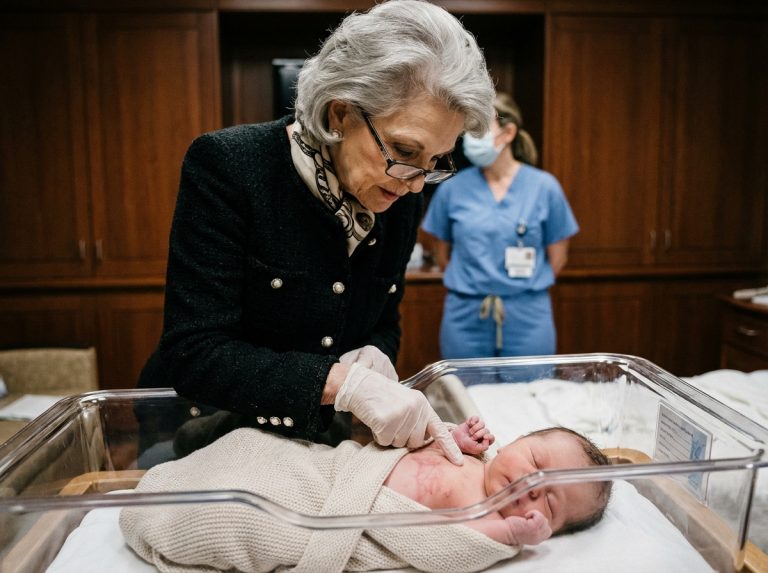
Dr. Aris reached down and expertly unbuttoned the front of Leo’s white cotton onesie. He pulled the fabric back, exposing the infant’s pale, rising and falling chest under the harsh, bright fluorescent lights mounted directly overhead.
The mark was centered over Leo’s left ribcage, stretching upward toward his collarbone. It wasn’t a standard, flat port-wine stain. It was a deep, violently dark purple vascular malformation. Raised, intricate veins spider-webbed across his translucent skin in a distinct, almost symmetrical pattern. It looked heavy, organic, and startlingly complex, like a sprawling root system branded directly into his flesh. It had darkened significantly since the hospital, the purple hue becoming sharper, more defined against his pale skin.
The room fell dead silent.
I watched Dr. Aris. His cheerful, practiced smile slipped, replaced by a look of intense, clinical curiosity. He leaned in closer, his brow furrowing as he inspected the raised purple lines.
I didn’t look at Evelyn right away. But I felt the shift in the room. The atmospheric pressure seemed to drop instantly.
When I finally turned my head, what I saw stopped the breath in my throat.
Evelyn Vance was gone.
The polished, untouchable Highland Park socialite who had commanded the room seconds earlier had vanished. Her face was entirely drained of blood, rendering her skin the color of wet ash. Her perfectly manicured hands were gripping the edge of the stainless-steel counter so hard her knuckles were bone-white. Her mouth hung slightly open, her chest heaving in rapid, shallow jerks. Her eyes—usually cold and calculating—were blown wide, completely completely consumed by a raw, unadulterated terror.
She wasn’t looking at Leo as a grandmother. She was staring at his chest like she was looking at a ghost.
“Mom?” Carter asked, his voice cracking. He dropped his hand from my shoulder and took a step toward her. “Mom, are you okay? You look faint.”
Evelyn didn’t blink. She didn’t acknowledge him. A low, ragged sound rattled in the back of her throat, like a trapped animal drawing its last breath.
“No,” she whispered. The word was barely audible, scraped out of her. “No, no, no. Impossible.”
“Evelyn?” Dr. Aris asked, glancing up from the baby. “Are you alright?”
“It’s the mark,” Evelyn muttered, her eyes darting frantically around the room, as if expecting the walls to suddenly collapse inward. Her voice was climbing in pitch, slipping into a frantic, breathless hysteria. “The bloodline. He found us. The Sovereign is going to find us.”
“Mom, what are you talking about?” Carter moved closer, reaching out to touch her arm.
Evelyn flinched violently, slapping Carter’s hand away with a force that echoed off the tile walls. Carter stumbled back, his face falling into absolute shock. I pushed myself up from the chair, the sudden movement tearing at my C-section incision, a hot wire of pain shooting through my abdomen. My sole instinct was to get to the table. To cover Leo. To get my son away from whatever was happening to this woman.
“It’s just a vascular anomaly,” Dr. Aris said, his tone shifting from friendly to authoritative, trying to regain control of the room. He picked up his medical tablet. “It’s rare, yes. It’s a specific genetic marker. I just need to photograph this for the national database. It’s standard protocol for anomalies of this nature, so specialists can—”
He raised the tablet, the camera lens facing the baby.
Evelyn snapped.
There was no warning. No build-up. The sheer violence of her movement was so completely out of place in that sterile, expensive room that my brain failed to process it for a fraction of a second.
She lunged away from the counter. Her hand swept across the stainless-steel surgical tray resting near the sink. Her fingers locked around the heavy, steel medical shears used for cutting thick dressings.
“Do not send that!” Evelyn shrieked, the sound tearing from her throat with a volume that vibrated in my teeth.
She slammed into Dr. Aris before he could even lower the tablet. The doctor stumbled backward, his mouth opening in surprise. Evelyn didn’t pause. She didn’t hesitate. With a guttural, terrifying roar, she raised the shears and drove the thick, blunt metal blades directly into the side of Dr. Aris’s neck.
The sound of the impact was wet and heavy.
Dr. Aris let out a wet, gargling choke, his eyes rolling back. The tablet clattered to the linoleum floor, the screen shattering. A sudden, pressurized spray of bright arterial blood hit the frosted glass window behind him in a horrific, diagonal slash. The doctor staggered, his hands flying up to his ruined throat, blood pouring through his fingers as he collapsed backward into the heavy supply cabinets.
Carter stood completely paralyzed. He didn’t scream. He didn’t move. He just stared at his mother, his mouth open, entirely broken by the impossibility of what he had just witnessed.
But I moved.
As the doctor went down, Evelyn pivoted instantly toward the examination table. Her eyes were completely unhinged, wild and desperate. She dropped the bloody shears to the floor and lunged for Leo.
“No!” I screamed, the sound ripping out of me as pure, primal panic.
I threw my body forward. The stitches in my abdomen stretched and popped, searing pain flooding my nerve endings, but I didn’t care. I hit the edge of the examination table just as Evelyn’s hands clamped around Leo’s small, fragile waist. She was trying to yank him off the paper, trying to sprint for the heavy oak door.
I grabbed her wrists. She was surprisingly strong, fueled by a terrifying, adrenalized madness.
“Let him go!” I shrieked, my fingers digging into her skin, pulling back with everything I had. “Carter! Help me!”
Carter remained frozen, a statue of pure shock, unable to bridge the gap between the mother who bought him cashmere and the woman currently covered in arterial spray.
“They’re coming!” Evelyn screamed in my face, her spit hitting my cheek. Her eyes were devoid of anything human. “The Covenant! They’ll kill us all! Let go of him!”
She yanked hard, dragging Leo across the paper. The baby began to wail, a sharp, terrified cry that cut through the chaos. I felt my grip slipping on her slick skin. In a desperate move, I drove my elbow directly into Evelyn’s face. The bone connected with her nose with a loud crunch.
She staggered back, her hands slipping from the baby. I immediately scooped Leo up, pulling him tightly against my chest, curling my body entirely around him to shield him from her. I backed into the corner of the room, my legs trembling, warm blood from my reopened incision soaking into my underwear.
Evelyn didn’t stop. Blood poured from her broken nose, staining her perfect cream blazer, but she didn’t even seem to register the pain. She let out another animalistic scream and lunged toward me, her hands reaching out like claws to rip my son from my arms.
Before she could reach me, the heavy clinic door was kicked open.
Two large security guards in dark uniforms burst into the room, their eyes frantically taking in the blood smeared across the glass, the dying doctor on the floor, and the screaming woman charging at a mother and infant.
“Get on the ground!” the lead guard roared.
Evelyn didn’t hear them. She was entirely lost to her own terror. She lunged for me again.
The first guard hit her at a full sprint. He tackled her around the waist, lifting her polished shoes off the linoleum and driving her hard into the floor. The impact shook the room. Evelyn fought back with feral intensity, thrashing, kicking, her manicured nails clawing at the guard’s face.
“Restrain her! Restrain her!” the second guard yelled, dropping his radio and throwing his weight onto Evelyn’s legs.
They wrestled her onto her stomach, pinning her limbs down. The sound of heavy metal handcuffs ratcheting tight echoed over Leo’s piercing cries.
“The Sovereign is coming!” Evelyn screamed into the bloody floor tiles, her voice raw and tearing. “He’s coming for the bloodline! We’re already dead!”
I collapsed against the wall, sliding down until I hit the floor. My whole body was shaking violently. I clutched Leo tightly against my chest, burying my face into his soft, warm head, trying to muffle his screams. I looked up through the chaos. Carter was still standing in the exact same spot, staring down at the pool of the doctor’s blood spreading across the white linoleum, his reality completely shattered.
And pinned beneath the heavy knees of the security guards, his mother continued to thrash and scream, completely unrecognizable from the woman who had walked into the room.
Chapter 2
The heavy oak door didn’t just open; it was shoved backward so hard the brass hinges groaned in protest. A wave of dark navy uniforms spilled into the sterile, violently altered examination room. Dallas PD had arrived, permanently shattering the insulated, million-dollar bubble of the Highland Park Pediatric Institute.
I didn’t let go of Leo. I stayed curled tightly in the corner of the room, my back pressed hard against the cool drywall. My breathing was ragged, catching in my throat every time I inhaled the sharp, unmistakable metallic stench of fresh blood. It was rapidly pooling across the white linoleum, creeping toward the toes of my shoes.
“Secure the suspect! Get paramedics in here now!”
The voices were loud, authoritative, overlapping in a chaotic blur of police radio static and heavy boots. Two patrol officers rushed the security guards who were still pinning Evelyn to the floor. They wrenched her arms backward with practiced, brutal efficiency. The loud, metallic ratcheting of police handcuffs snapping over her wrists cut sharply through the noise.
Through it all, Evelyn didn’t stop muttering. The frantic, ear-piercing shrieks from moments ago had devolved into a rapid, breathless litany. Her face was pressed into the bloody tiles, her broken nose smearing a dark red arc across the floor every time she thrashed her head.
“He’s coming. The Sovereign. The bloodline is exposed. We’re dead. We are all dead.” Her voice didn’t even sound like her own anymore. It was hollow, scraped out, devoid of the refined, elocution-class perfection she lorded over everyone in her life.
I squeezed my eyes shut, rocking my crying son against my chest. The pain in my abdomen was a steady, burning fire. My sudden, desperate lunge to save Leo from her grasp had ripped the healing tissue of my C-section. I could feel the warm, slick dampness of my own blood soaking through my underwear, sticking to the fabric of my sundress.
“Ma’am? Ma’am, I need you to look at me.”
I opened my eyes. A police officer was crouching in front of me. He didn’t look like the other young, adrenaline-fueled cops sweeping the room. He was older, somewhere in his mid-forties, with deep-set, exhausted eyes and heavy shoulders that carried the distinct posture of a man who had seen too much of the worst parts of the world. The silver nameplate on his dark uniform read RUIZ.
“Are you injured?” Officer Ruiz asked. His voice was a low, steady rumble. Grounding. Real. It was the first thing in the room that didn’t feel like a nightmare.
“I tore my stitches,” I managed to whisper, my voice shaking uncontrollably. “I had a baby. A month ago. She… she tried to take him.”
Ruiz’s dark eyes dropped to the blood staining my lap, then flicked to the wailing infant clutched against my chest. His expression hardened into a tight, professional grimace. He stood up and immediately keyed the radio clipped to his shoulder.
“Dispatch, I need a secondary bus at this location. I have a female victim, postpartum, bleeding from a surgical tear. We need to clear this room. It’s an active crime scene.”
He turned his attention across the room. Paramedics had already swarmed Dr. Aris. They were moving frantically, ripping open trauma kits and pressing thick gauze to the doctor’s ruined throat, but the desperate urgency in their movements was already fading into a grim, defeated resignation. There was simply too much blood on the walls.
“Hey,” Ruiz barked, stepping toward the center of the room. He was looking at Carter.
My husband was exactly where he had been when the shears went into the doctor’s neck. He was standing near the sink, his slate-gray cashmere sweater completely untouched by the carnage around him. His face was entirely blank. He wasn’t crying. He wasn’t shaking. He looked like the power cord to his brain had simply been unplugged.
“Sir, I need you to step out into the hall,” Ruiz said, waving a hand in front of Carter’s vacant eyes.
Carter blinked slowly, as if waking from a deep sleep. He looked down at the floor, staring blankly at the medical shears resting in a puddle of crimson. Then, very slowly, his eyes drifted toward the chaotic cluster of officers hauling his handcuffed mother up from the ground.
“That’s my mother,” Carter whispered. His voice was hollow, stripped of all its usual easy confidence. “She’s on the board of the museum. She doesn’t… she doesn’t do things like this.”
Ruiz didn’t offer any sympathy. He had zero patience for wealthy shock. “She just did, buddy. Now I need you out of this room.”
Ruiz gestured to a female officer. “Escort the husband and the mother to an empty room down the hall. Keep them away from the suspect.” He looked back down at me, his tone softening just a fraction. “Can you walk, ma’am? We need to get you out of this room before the detectives get here.”
I nodded tightly. I didn’t want to stay in this slaughterhouse for another second.
I pushed myself up the wall, biting hard into my bottom lip to keep from crying out as a hot wire of pain shot across my lower pelvis. I refused to let go of Leo. The female officer hovered her hands near my elbows, ready to catch me, but I shook my head, relying on pure, terrified adrenaline to keep my legs steady.
Carter finally moved. He stumbled toward me, his hands reaching out to help. “Harper. Harper, let me take him.”
I flinched backward so violently my shoulder hit the doorframe.
Carter froze, his hands suspended in the air. The look of profound hurt that crossed his face almost made me feel guilty, but the primal, protective rage flooding my system instantly crushed it. He had stood there. While his mother drove a blade into a man’s neck, while she lunged to steal our child, the man who had promised to protect us had simply stood there.
“Don’t touch me,” I hissed, my voice trembling with a terrifying, venomous clarity. “Don’t you dare touch him.”
Carter shrank back, his mouth opening and closing like a suffocating fish. He dropped his hands and looked away, wrapping his arms around his own torso.
The officer guided us down the pristine, brightly lit corridor. The contrast was deeply nauseating. Just thirty feet away, a man was bleeding to death on the floor, but out here, the clinic still looked like an upscale day spa. We were ushered into a private consultation room. It was furnished with heavy mahogany chairs, a frosted glass table, and a small built-in refrigerator stocked with sparkling water.
I sank into one of the leather chairs, grimacing as the pressure hit my torn incision. I unclipped my dress, shifted my bra, and guided Leo to my chest. He latched immediately, his frantic, terrified cries finally subsiding into rapid, exhausted gulps. I buried my face in his soft hair, closing my eyes, trying to block out the world.
Carter paced. He walked back and forth across the small room, his expensive leather shoes squeaking softly on the polished hardwood floor. He was muttering to himself, building the architecture of his denial brick by brick.
“It was a psychotic break,” Carter said, dragging a trembling hand through his hair. He wasn’t talking to me. He was pleading with the universe. “It has to be. A bad reaction to her new medication. She’s been stressed about the country club renovations. She hasn’t been sleeping. People snap. It happens. It’s a medical episode.”
I kept my eyes closed. I didn’t have the energy to fight his delusions. I had spent two years in this marriage watching Carter bend reality to excuse his mother’s cruelty. When she belittled my background, he called her “old-fashioned.” When she tried to control our finances, he called her “protective.” But you couldn’t rebrand murder. You couldn’t dress up a slaughter in Highland Park vocabulary.
The door handle clicked. Officer Ruiz stepped into the room.
He didn’t look like a beat cop checking on victims anymore. The tired irritation had completely vanished from his posture. He moved with a tight, coiled tension. He reached behind him and pressed the button on the doorknob. The heavy metallic thud of the deadbolt locking echoed in the small room.
He wasn’t carrying a notepad. He was holding a heavy, ruggedized black device that looked like a thick smartphone with a glowing green biometric pad attached to the bottom. It was a mobile AFIS scanner, the kind patrol officers used to identify John and Jane Does in the field.
Ruiz looked at Carter. His eyes were hard, unreadable.
“Mr. Vance, take a seat,” Ruiz said. It wasn’t a suggestion.
Carter stopped pacing but didn’t sit. He crossed his arms protectively. “Officer, I need to call our attorneys. The firm of Davis and Lockhart. They need to be here before my mother is questioned. This is clearly a severe psychiatric emergency. She requires immediate medical evaluation, not police interrogation.”
Ruiz ignored the speech entirely. He pulled out one of the mahogany chairs, turned it around, and sat down heavily, resting his forearms on the backrest. He placed the biometric scanner on the glass table.
“Your mother didn’t have any identification on her,” Ruiz said, his voice deadly calm. “No driver’s license in her Prada bag. No credit cards with her name on them. Nothing. Just ten thousand dollars in banded cash shoved into a side pocket.”
Carter blinked. “That’s… that’s impossible. She never carries cash. She hates cash. And her ID is always in her wallet.”
“Well, she didn’t have it today,” Ruiz replied. “And since she was actively fighting my officers and babbling incoherently, she became a Jane Doe in a homicide investigation. So, before they loaded her into the transport vehicle, I rolled her thumbs on this.” He tapped the black device on the table. “Standard mobile fingerprint scan. Runs directly to the state and federal databases. Takes about three minutes for a return.”
“Then you know exactly who she is,” Carter said, his voice rising with defensive arrogance. “Evelyn Vance. She’s lived in Highland Park for nearly thirty years. Her name is on the new wing of the downtown library, for God’s sake. You can look it up.”
Ruiz stared at Carter for a long, heavy moment. The silence in the room became suffocating. The only sound was the soft, rhythmic suckling of my son against my chest.
“Evelyn Vance doesn’t exist,” Ruiz said quietly.
Carter let out a sharp, incredulous laugh. “What? That’s ridiculous. The machine is broken. Or you scanned her wrong.”
“The machine works fine,” Ruiz countered, leaning forward. “Evelyn Vance is a ghost identity. A very expensive, very thorough fabrication. Social Security number, birth certificate, credit history—all manufactured and backdated to the mid-nineties. The database didn’t flag an Evelyn Vance.”
Ruiz picked up the device and turned the screen around. A mugshot illuminated the glass. It was an old photograph, grainy and faded, but the bone structure was undeniable. The icy, piercing eyes. The sharp jawline. It was Evelyn, thirty years younger, without the expensive blowouts and surgical enhancements.
Beneath the photo, a banner flashed in stark, bright red pixels: LEVEL ONE FEDERAL FUGITIVE. ARMED AND HIGHLY DANGEROUS.
“The FBI database flagged her as Martha Hayes,” Ruiz said, his voice dropping an octave. “Wanted by the Department of Justice, the Bureau of Alcohol, Tobacco, and Firearms, and the FBI’s Domestic Terrorism Task Force for the last three decades.”
I stopped breathing. The air in the room felt like it had turned to concrete.
Carter stared at the glowing screen. His face was completely devoid of comprehension. “Martha… what? No. No, you have the wrong person. My father was Richard Vance. He was an investment banker. He died of a heart attack when I was four. She’s his widow. I grew up in this city.”
“Richard Vance was a real person who died in 1993 with no next of kin,” Ruiz corrected, his tone completely flat, dismantling Carter’s reality piece by piece. “Your mother bought his name. She assumed the identity of his widow to launder her own existence. She bought her way into Highland Park with a whole lot of dirty money to hide in plain sight.”
“Hide from what?” I asked. My voice sounded tiny, alien in my own ears.
Ruiz shifted his gaze to me. “The Iron Covenant.”
The name sent a dark, primal chill down my spine. I had heard the name on late-night true-crime documentaries and deep-dive news specials. It wasn’t a street gang. It was a ghost story.
“They’re an Appalachian anti-government militia,” Ruiz explained, his eyes locking onto Carter’s pale, trembling face. “Started in the late eighties. They aren’t just off-the-grid survivalists. They are a heavily armed, highly organized domestic terror syndicate. They traffic illegal weapons across state lines, stockpile military-grade explosives, and operate sleeper cells embedded in regular society. They believe the federal government is an illegitimate, satanic corporation. They are absolute, uncompromising fanatics.”
Carter shook his head violently, backing away from the table. “Stop. Stop it. My mother hosts charity galas. She drinks chardonnay at the country club. She complains about the landscaping. She is not a terrorist.”
“She isn’t just a terrorist, Mr. Vance,” Ruiz said mercilessly. “Martha Hayes was the wife of Josiah Hayes. The founder. The man they call ‘The Sovereign.’ She was the matriarch of the entire Covenant.”
Carter hit the wall behind him. His knees buckled slightly, but he caught himself. “No. No, you’re lying. This is insane.”
“Thirty years ago, right before a massive federal raid on their compound in the mountains, Martha Hayes vanished,” Ruiz continued, relentless. “She didn’t just run. She took a massive portion of the syndicate’s operational cash. And she took something else.”
Ruiz stood up slowly. He didn’t look at Carter. He looked down at me, and then specifically, at the baby nursing at my breast.
“She took Josiah’s infant son,” Ruiz said quietly.
The silence that followed was absolute. It was the sound of a universe collapsing inward.
I looked up at Carter. He was entirely broken. The fragile, privileged shield he had spent his entire life hiding behind had just been shattered into a million irreparable pieces. His eyes were wide, darting frantically around the room, begging for an escape hatch that didn’t exist.
“No,” Carter gasped, clutching his own chest. “No, I’m Carter Vance. I went to SMU. I’m… I’m Carter.”
“She didn’t run to save you from him,” Ruiz said, his voice dropping into a dark, cynical register. “If she cared about you, she wouldn’t have brought you to a public hospital with a genetic marker that could identify you. She ran out of spite. She stole you to cripple Josiah’s legacy.”
“What genetic marker?” I asked, my grip tightening on Leo.
Ruiz pointed directly at my son. “The doctor was trying to photograph a birthmark, wasn’t he? A dark purple, web-like mark on the chest.”
My heart hammered against my ribs like a trapped bird. “Yes. The nurses said it was just a vascular anomaly.”
“It is an anomaly,” Ruiz confirmed grimly. “It’s a highly specific, localized vascular dysplasia. It’s incredibly rare. But more importantly, it’s hereditary. Josiah Hayes has it. It’s well-documented in his federal files. His inner circle views it as a divine brand. Proof of the chosen bloodline. The true heir to the Covenant.”
Ruiz turned back to Carter. The older officer looked almost sympathetic for a fleeting second before the hard, tactical reality settled back over his features.
“The moment your mother saw that mark on your son’s chest, she knew,” Ruiz said. “She knew that the second that doctor uploaded the photo to a national database, the Covenant would be flagged. They have people everywhere. In hospitals, in police precincts, in the power companies. She knew Josiah would finally find his stolen son. And his new grandson.”
Carter didn’t argue anymore. The fight completely drained out of his body. He looked like a man who had just been told he had minutes left to live. He stumbled forward, his legs barely supporting his weight, and collapsed heavily into the leather chair opposite the desk.
He didn’t look at me. He didn’t look at the officer.
His trembling hands reached up to the collar of his slate-gray cashmere sweater. With agonizing slowness, his fingers fumbled with the buttons. He pulled the soft, expensive fabric aside, and then grabbed the collar of his white cotton undershirt, stretching the neckband downward, exposing the center of his chest.
I stopped breathing entirely.
There, resting directly over his heart, etched into his pale skin, was a faded, intricate web of purple veins. It was older, less angry, but the pattern was absolutely identical to the heavy, violent brand blooming across my newborn son’s ribs.
Carter sat in the sterile luxury of the clinic, staring blindly at the wall, realizing in one horrifying, paralyzing instant that his entire thirty years of existence had been nothing but an elaborate, stolen lie.
Chapter 3
The consultation room was completely, horrifyingly silent. It was a thick, suffocating quiet, broken only by the soft, rhythmic hum of the central air conditioning pumping through the ceiling vents and the quiet, exhausted breaths of my son sleeping against my chest.
I stared at Carter. I couldn’t look away from the center of his chest.
The pale skin there was marred by the faded, intricate web of purple veins. It wasn’t just a birthmark. It was a mirror. It was the exact same heavy, sprawling pattern that rested on the ribs of the fragile infant currently curled in my arms. A brand. A genetic receipt linking my husband, and now my child, to a bloodline of violent, uncompromising extremists.
Carter’s hands were trembling so violently he couldn’t even manage to rebutton his collar. He just sat there in the heavy leather chair, his shoulders slumped forward, staring blindly at the frosted glass table. His slate-gray cashmere sweater hung open, exposing the horrifying truth of his existence. He looked like a man who had just survived a high-speed car crash, completely devoid of thought, simply existing in the hollow vacuum of shock. His entire thirty years of life—the country clubs, the private schools, the trust funds, the memories of a father who never existed—had been systematically dismantled and vaporized in less than three minutes.
He didn’t have a name. He didn’t have a family. He was a stolen piece of property. And the people who owned him were coming to take him back.
“Carter,” I whispered.
He didn’t blink. He didn’t register his name. Why would he? It wasn’t his name anyway.
I looked up at Officer Ruiz. The older man was watching Carter with a cold, analytical detachment. He didn’t look surprised. He looked like a man mentally calculating the odds of a situation that had just gone from terrible to catastrophic. He reached down and scooped his heavy biometric scanner off the table, shoving it back into the utility pouch on his tactical belt.
“Mr. Vance,” Ruiz said, his voice a low, steady rumble of authority. He didn’t raise his volume, but the absolute command in his tone cut through the sterile air of the room. “I need you to pull yourself together right now. Look at me.”
Carter’s eyes slowly lifted from the table. They were vacant, glassy, entirely stripped of the easy, privileged confidence he had carried since the day I met him in a crowded Denton coffee shop.
“My name is Carter Vance,” he repeated softly, his voice trembling on the edge of a total psychological break. “I grew up in Highland Park. My father was Richard Vance. He died when I was four.”
“Your father is sitting in a federal supermax prison in Florence, Colorado, serving four consecutive life sentences for domestic terrorism,” Ruiz corrected brutally. He didn’t have the time or the inclination to coddle Carter’s shattered reality. “And the woman who raised you is currently bleeding on the floor of an examination room down the hall in handcuffs. Your past doesn’t matter anymore, son. The only thing that matters right now is keeping your wife and your baby breathing for the next twenty minutes. Do you understand me?”
Carter opened his mouth, but no sound came out. He just stared at the officer, completely paralyzed by a terror he couldn’t even begin to process.
A sharp, sudden pain ripped across my lower abdomen, pulling me out of the paralyzing shock. I hissed, squeezing my eyes shut as the fresh, tearing sensation radiated outward from my C-section incision. The warm, slick dampness of my own blood was spreading further down my thighs, soaking heavily into the cotton of my underwear and sticking to the leather of the chair. My body was rapidly reaching its absolute physical limit.
“We need to get out of this building,” I said, my voice shaking but laced with a sudden, desperate clarity. The primal, chemical instinct of a mother protecting her young was violently overriding my physical agony. “You said they have people everywhere. You said they were coming.”
“They are,” Ruiz confirmed grimly. He unclipped his heavy black radio from his shoulder. “The Covenant doesn’t operate like a street gang. They are structured, heavily armed, and deeply embedded. The fact that the doctor was entering your son’s specific genetic anomaly into a networked medical tablet means they already know. They monitor the databanks. The moment that code hit the cloud, an alert went out. They have sleeper cells working in logistics, medical administration, city infrastructure. They are going to lock this place down to retrieve the bloodline.”
Ruiz pressed the transmission button on his radio. “Dispatch, this is Unit 4-Bravo. I have a Code 3 emergency at the Highland Park Pediatric Institute. Suspect in custody is a confirmed Level One federal fugitive. I need immediate tactical backup, SWAT deployment, and a perimeter lockdown. Be advised, we may have organized hostile actors inbound to this location. Acknowledge.”
He released the button.
Nothing but a harsh, empty hiss of static echoed back through the speaker.
Ruiz frowned. He pressed the button again, holding it down harder. “Dispatch, do you read? I need immediate tactical response. Emergency traffic only.”
Static. A dense, heavy wall of white noise that sounded entirely unnatural.
Ruiz slowly lowered the radio, his jaw clenching tight. His eyes flicked to the ceiling vents, then to the heavy frosted glass door of the consultation room. The exhausted, irritated cop was completely gone. In his place stood a man who realized he was entirely cut off from the rest of the world.
“They’re jamming the local frequencies,” Ruiz muttered, his hand dropping instinctively to the heavy, black polymer grip of the Glock 17 holstered on his right hip. “They’re already here.”
The moment the words left his mouth, the building died.
It wasn’t a flicker. It wasn’t a gradual dimming of the lights. It was an instant, violent cessation of all electrical power. The steady, comforting hum of the central air conditioning cut off abruptly, plunging the room into a deafening, pressurized silence. The bright, sterile fluorescent panels overhead went completely black. The digital clocks on the wall vanished. The small refrigerator in the corner stopped humming.
The heavy, suffocating darkness only lasted for exactly three seconds.
Deep within the walls of the clinic, a heavy, mechanical clunk reverberated through the floorboards. The backup emergency generators kicked online.
A row of harsh, crimson emergency lights mounted along the baseboards and above the doorframes flickered violently to life. The sterile, expensive white-and-cream aesthetic of the Highland Park clinic was instantly drowned in a sickly, blood-red glow. The shadows in the room stretched and warped, transforming the elegant mahogany furniture into sharp, menacing silhouettes.
My breath caught in my throat. I pulled Leo tighter against my chest, curling my body entirely around his fragile frame. He stirred in his sleep, letting out a soft, disgruntled sigh, completely oblivious to the nightmare descending around him.
“They cut the main grid to the building,” Ruiz said. His voice was a tight, controlled whisper now. The rules of engagement had fundamentally shifted. “It’s not a local power failure. It’s a targeted blackout. They’re blinding the security cameras and shutting down the electronic locks.”
“Oh my god,” Carter gasped, finally snapping out of his catatonic stare as the red emergency lights washed over his face. He scrambled backward in his chair, his shoes scraping loudly against the hardwood floor. “We have to call the police. My phone. Where is my phone?”
He began slapping his pockets frantically, his movements jerky and uncoordinated.
“Don’t bother,” Ruiz snapped, stepping quickly to the door and pressing his ear against the heavy oak paneling. “If they have signal jammers strong enough to block police bands, your cell phone is just an expensive paperweight. We are entirely on our own.”
“Then we leave,” I said, forcing the words out through the burning pain in my pelvis. I pushed myself to the edge of the leather chair. “We walk out the front door right now. We take the stairs.”
“No,” Ruiz replied instantly. He pulled his sidearm from its holster, the metallic click of the safety disengaging sounding terrifyingly loud in the quiet room. “The front doors are a fatal funnel. If they killed the power, they’ve already secured the exits. They aren’t going to let anyone out until they have what they came for. Which is sitting right there in your arms.”
I looked down at the dark, sprawling brand on Leo’s chest. My stomach violently churned. I reached down and quickly snapped the cotton onesie closed, burying the mark beneath the fabric as if hiding it could somehow erase the reality of what it meant.
“So what do we do?” Carter asked, his voice cracking into a high-pitched, pathetic whine. He was practically vibrating with terror. “We can’t just wait here for them to kill us!”
“We move,” Ruiz said, his eyes scanning the red-lit room. “But we don’t go down. We move laterally. This is a secure medical facility. There are secondary service corridors, laundry chutes, and heavily reinforced supply rooms. We need to find a blind spot and hole up until the local patrol units realize I’ve gone dark and send backup to investigate.”
Ruiz turned the deadbolt on the consultation room door. He looked back at me, his eyes dropping to the blood staining the front of my dress.
“Can you walk?” he asked, his tone stripped of any polite bedside manner. It was a purely tactical assessment.
“I have to,” I said.
I forced myself to stand. The moment my weight settled onto my legs, a blinding, white-hot flash of agony ripped through my lower abdomen. My vision momentarily swam, the red emergency lights blurring into a chaotic smear of color. I bit down so hard on my bottom lip that I tasted copper, refusing to let the scream escape my throat. I couldn’t be weak. Not now. I shifted Leo’s weight higher onto my chest, wrapping my arms tightly around his back.
“Carter,” I rasped, my voice thick with pain. “Get up.”
Carter didn’t move. He was staring at the heavy Glock in Ruiz’s hand, his chest heaving in rapid, shallow jerks. “I can’t. I can’t do this. I’m just an investment consultant. I don’t… I don’t know how to do this.”
Rage—hot, primal, and deeply clarifying—flooded my veins, temporarily burning away the pain in my stomach. I took a staggering step forward and grabbed the collar of Carter’s expensive cashmere sweater. I yanked him hard.
“Get up!” I hissed directly into his face. “I don’t care who you thought you were. I don’t care about your mother. I don’t care about your father. The only thing that matters is this baby. You are going to stand up, you are going to walk out that door, and you are going to help me keep our son alive. Do you hear me?”
Carter blinked rapidly, tears finally spilling over his lower lashes. The sheer venom in my voice seemed to shock him back into his body. He gave a jerky, terrified nod. He pushed himself out of the chair, his legs visibly trembling beneath him.
“Good,” Ruiz grunted. He stepped over to the door and gripped the heavy brass handle. “Stay behind me. Stay low. Do not make a sound unless I tell you to. If shooting starts, you drop to the floor and you do not move. Understood?”
We both nodded.
Ruiz slowly turned the handle and pulled the door open.
The main corridor of the Highland Park Pediatric Institute was completely transformed. The wide, polished hallway, usually flooded with natural sunlight and the quiet murmurs of wealthy parents, was now a long, terrifying tunnel of deep shadows and harsh red emergency lighting. The large, frosted glass double doors at the far end of the hall, which led to the central elevator bank and the main reception area, were closed, glowing like a dark, bloody monolith in the dim light.
The silence out here was different. It wasn’t empty. It was expectant.
Somewhere down the hall, the faint, rhythmic beeping of battery-operated medical monitors echoed from the examination rooms. The sharp scent of iron and fresh blood from Dr. Aris’s murder hung heavily in the stagnant air, completely overpowering the smell of imported lavender.
Ruiz stepped out into the corridor, sweeping the barrel of his weapon in a tight, controlled arc. The hallway was empty. He signaled for us to follow.
I stepped out, my posture hunched forward, fiercely protecting the center of my mass where Leo was sleeping. Every step was a fresh wave of tearing pain. I felt the warm blood trailing down the inside of my thigh, but I forced my legs to keep moving, matching Ruiz’s slow, methodical pace. Carter walked practically glued to my back, his breathing ragged and loud in my ear.
We had made it exactly fifteen feet down the corridor when the sound started.
It wasn’t a sudden explosion. It wasn’t chaotic shouting. It was something infinitely more terrifying.
Clank. Clank. Clank.
The heavy, metallic grinding echoed from the walls, vibrating up through the floorboards. It was the sound of the main elevator shafts. Without power, the magnetic brakes should have engaged, holding the cars in place. But the sound wasn’t stopping. It was the heavy, terrifying screech of the elevator cars being manually released and dropped to the ground floor to be permanently locked out. They were severing our vertical escape routes.
Ruiz froze, raising his hand in a tight fist. We stopped immediately.
Then, a new sound replaced the grinding metal.
It came from the heavy steel fire doors that sealed off the emergency stairwells at the far end of the corridor. It was faint at first, muffled by the thick acoustic paneling of the clinic, but it was growing steadily louder.
Thud. Thud. Thud.
It was the sound of heavy, tactical boots ascending the concrete stairs. There was no frantic rushing. There was no chaotic scrambling. The footsteps were synchronized, deliberate, and entirely calm. It was the chilling, unmistakable rhythm of a highly trained, militarized unit moving in formation. The Iron Covenant wasn’t sending a mob of angry zealots. They had sent a professional hit squad.
“They’re taking the stairs,” Ruiz whispered, his voice incredibly tight. “They’re coming up from the basement garage. We need to find cover. Now.”
He abandoned his slow, sweeping pace and began moving rapidly down the hallway, keeping his back pressed against the wall. We hurried after him, the frantic movement aggravating the torn tissue in my abdomen. I bit back a sob of pain, focusing entirely on the back of Ruiz’s dark uniform.
We reached a junction in the corridor. To the left was a set of heavy wooden double doors leading to the medical records archive. To the right was a short hallway ending in a reinforced frosted glass door marked STAFF ONLY – MEDICAL SUPPLY.
“In there,” Ruiz commanded, pointing toward the supply door. “It’s a dead end, but the door is steel-reinforced behind the glass. We can barricade it.”
We moved quickly toward the short hallway. I was limping heavily now, the pain radiating down into my knees. Carter reached out, finally attempting to help, grabbing my elbow to steady me.
We were halfway down the short corridor when a dark, massive silhouette suddenly materialized behind the frosted glass of the main hallway double doors behind us.
The figure didn’t look like a security guard. It was large, broad-shouldered, entirely encased in black tactical gear. A heavy ballistic helmet obscured the head, and a long, matte-black rifle was raised tightly to the shoulder.
Ruiz spun around instantly, stepping completely in front of us, shielding me and the baby with his own body. He raised his Glock, aiming directly at the center of mass behind the frosted glass.
“Police! Drop your weapon!” Ruiz roared, his voice echoing violently in the confined space.
The silhouette behind the glass didn’t flinch. It didn’t hesitate. It simply adjusted its aim.
There was no deafening crack of a gunshot. There was only a rapid, sickeningly quiet series of sounds.
Pfft. Pfft. Pfft.
The heavy frosted glass shattered inward, disintegrating into a shower of thousands of glittering, lethal fragments that cascaded across the red-lit linoleum.
Ruiz violently jerked backward as if he had been struck by an invisible sledgehammer. A sudden, pressurized spray of blood erupted from the side of his right thigh. The suppressed, high-velocity rifle round had completely shattered his femur.
The officer didn’t scream. A sharp, guttural grunt tore from his throat as his leg entirely collapsed beneath him. He hit the floor hard, his heavy duty belt crashing against the tile. His Glock clattered out of his grip, sliding across the blood-slicked linoleum toward the shattered glass.
“Ruiz!” I screamed, the sound tearing out of me before I could stop it.
“Get down!” Ruiz roared, clutching his leg, bright arterial blood already rapidly pooling around his knee.
Carter screamed, a high, piercing sound of pure, unadulterated panic. He threw his hands over his head and flattened his back against the wall, sliding down to the floor, completely paralyzed by the sudden eruption of violence. He made no move to grab the gun. He made no move to help the bleeding man on the floor.
I looked at the shattered double doors. Through the jagged remnants of the glass, I could see two more heavily armed figures stepping out of the emergency stairwell, their rifles raised, moving with terrifying, silent precision into the main corridor. They were beginning to clear the examination rooms one by one.
We had seconds before they reached the junction.
I didn’t think. The maternal, protective rage that had been simmering in my blood exploded into a terrifying, singular focus. I could not let my son die in this hallway.
I shoved Leo hard against my chest, securing him tightly with my left arm. I dropped to my knees beside Officer Ruiz. The pain in my torn abdomen flared so violently I thought I was going to pass out, black spots dancing furiously at the edge of my vision. I ignored it.
I grabbed the thick nylon webbing of the tactical vest strapped over Ruiz’s shoulders.
“What are you doing?!” Ruiz gritted out, his face pale, sweat rapidly beading on his forehead as he tried to clamp his hands over the massive hole in his leg.
“Shut up and help me!” I hissed.
I planted my feet on the slick, bloody linoleum and pulled. The heavy, dead weight of the two-hundred-pound officer dragged across the floor. My abdominal muscles screamed, a sickening tearing sensation ripping through the lower half of my body as fresh, hot blood poured down my legs. I let out a guttural, animalistic sound of pure exertion, throwing every ounce of my remaining strength into pulling him backward.
“Carter! Open the door!” I screamed over my shoulder.
Carter scrambled on his hands and knees, pushing the heavy STAFF ONLY door open and holding it wide.
I hauled Ruiz backward, sliding him across the threshold into the dark, windowless supply closet. The air inside smelled sharply of rubbing alcohol and fresh linens. I dropped his vest, collapsing onto my knees beside him, my chest heaving, my breath coming in ragged, bloody gasps.
Carter scrambled into the room after us, pulling the heavy reinforced door shut with a solid, metallic click just as the synchronized, heavy thud of tactical boots stepped out onto the linoleum of the main hallway.
Harper, bleeding through her clothes from her surgical scars, must drag the wounded officer into a supply closet as armed men begin clearing the hallway room by room.
Chapter 4
The supply closet was a cramped, windowless rectangle that smelled violently of industrial rubbing alcohol, fresh cotton linens, and the thick, hot copper stench of human blood. The heavy steel-reinforced door clicked shut, plunging us into absolute darkness for a fraction of a second before a single, caged emergency bulb flickered on overhead, bathing the small space in a dim, sickly red glow.
I collapsed backward against a towering rack of folded hospital gowns, my legs finally giving out. I clutched Leo tightly to my chest, my entire body violently shaking. The pain radiating from my torn C-section incision was no longer a sharp, localized fire; it was a deep, consuming agony that felt as if my entire lower abdomen was being slowly unzipped. I could feel the hot, sticky wetness of my own blood pooling in my lap, soaking entirely through the thin cotton of my sundress.
On the floor beside me, Officer Ruiz was in the process of bleeding to death.
He had dragged himself into the center of the tiny room, his back pressed against a stack of cardboard medical supply boxes. His right leg was completely destroyed. The high-velocity rifle round had shattered his femur, tearing a massive, jagged exit wound through the back of his thigh. Bright, highly oxygenated arterial blood was pumping onto the white linoleum in rhythmic, terrifying spurts, matching the frantic beat of his heart.
“Belt,” Ruiz grunted, his voice a tight, breathless rasp. He was digging his thumbs viciously into the top of his own thigh, trying to manually pinch the femoral artery against his pelvic bone. His face was gray, a sheen of cold sweat illuminating his skin in the red light. “The kid. Get his belt.”
I looked up. Carter was pressed against the opposite wall, his hands flat against the drywall, his chest heaving as he stared at the carnage on the floor. He was hyperventilating, his eyes blown wide, trapped in a state of absolute, paralyzing shock.
“Carter!” I hissed, my voice cracking. I shifted Leo to my left arm and reached out, grabbing the hem of Carter’s slate-gray cashmere sweater. “Give him your belt! Now!”
Carter blinked, the command barely penetrating the thick fog of his panic. He looked down at his waist, his trembling fingers fumbling blindly with the silver buckle of his expensive Italian leather belt. He pulled it free with a sharp yank, the leather whipping through the loops, and dropped it onto the floor as if it burned him.
Ruiz didn’t wait for help. He snatched the leather strap, wrapping it high and tight around his upper thigh, inches above the shattered meat of his leg. He threaded the tail through the buckle, bit down hard on the collar of his uniform shirt, and pulled the leather with a brutal, uncompromising violence. A muffled, guttural groan tore from his throat as the makeshift tourniquet bit deep into his muscle. The rhythmic spurting of blood immediately slowed to a dark, sluggish seep.
“It won’t hold long,” Ruiz panted, his head dropping back against the cardboard boxes. He looked up at the heavy steel door.
Out in the main hallway, the terrifying silence had returned. The heavy, synchronized thud of tactical boots had stopped. They had reached the junction.
Click. The sound was muffled by the heavy door, but it was unmistakable. It was the sound of a door handle being tested. Then, the heavy, deadened thud of a boot kicking against wood. They were clearing the examination rooms. Methodically. Brutally. Room by room, making their way down the corridor.
“They’re going to find us,” Carter whispered, sliding down the wall until he hit the floor, pulling his knees to his chest. He buried his face in his hands. “We’re going to die in a closet. My mother… my mother brought them here.”
“Shut up,” I snapped, the venom in my voice surprising even me. I didn’t have room for his existential crisis. I had a child to keep alive. I looked at Ruiz. “You said we had to move laterally. There’s no other door in here. We’re trapped.”
Ruiz was breathing heavily, his dark eyes scanning the cramped room. He reached down to his right ankle, his hand disappearing beneath the hem of his uniform trousers, and pulled a small, matte-black subcompact pistol from a concealed holster. His service weapon was still lying out in the hallway, lost in the shattered glass. He checked the chamber of the backup gun with a sharp click.
“We aren’t trapped,” Ruiz said quietly, pointing the barrel of the small pistol toward the back corner of the closet. “Standard architectural protocol for high-end medical facilities. They don’t drag bloody sheets and biohazards through the front lobby where the rich folks can see them.”
I followed his aim. Set flush into the drywall, behind a rolling cart of sterile saline bags, was a wide, stainless-steel square door with a heavy latch. The engraved plastic sign bolted to the wall above it read: SOILED LINENS – BASEMENT DROP.
“It’s an industrial laundry chute,” Ruiz explained, his voice tight with pain. “It drops straight down to the basement collection room, right off the underground parking garage. It’s gravity-fed. Wide enough to fit standard collection bags. Wide enough for a person.”
Outside, another door was kicked open. It sounded closer. Only two rooms away.
Pfft. Pfft. Two suppressed shots echoed through the drywall. They were executing anyone they found hiding.
“We have to go,” I said, a fresh spike of adrenaline completely overriding the burning agony in my pelvis. I shoved myself off the floor, gritting my teeth against the tearing sensation in my flesh. I shoved the rolling cart aside, exposing the steel hatch. I threw the heavy metal latch and pulled the door open.
A rush of cool, foul-smelling air hit my face, carrying the distinct scent of bleach, damp cotton, and exhaust fumes from the garage far below. The chute was a dark, vertical tunnel of polished aluminum.
“I’ll go first,” Ruiz said, dragging himself across the slick, bloody linoleum. “If there’s a jam, or if the bin at the bottom is empty, I’ll take the impact. You follow right behind me. The husband goes last.”
Carter didn’t argue. He just watched, his face entirely hollowed out.
Ruiz hauled his upper body into the stainless-steel opening. He didn’t hesitate. With a final, agonizing grunt, he pushed off his good leg and slid into the darkness. The metallic scraping of his duty belt against the aluminum echoed up the pipe, followed seconds later by a heavy, muffled thud deep below.
“He’s down,” I whispered. I looked down at Leo. He was still sleeping, his tiny fists curled tightly against his chest, completely insulated from the nightmare. I pulled my arms tighter around him, tucking his head beneath my chin to protect his fragile neck.
I sat on the ledge of the chute. The cold metal bit into my thighs.
“Carter,” I said, looking back at my husband. He was still sitting on the floor. “Get up. Now.”
He moved like a sleepwalker, crossing the small room and standing beside the open hatch. He looked down into the dark abyss, his hands shaking violently.
“I’ll see you at the bottom,” I said.
I pushed off the ledge.
The drop was terrifying. The absolute darkness of the chute swallowed me instantly. I fell backward, sliding at a steep, sickening angle, the slick aluminum rushing past my skin. I squeezed my eyes shut, curving my spine, focusing entirely on keeping Leo secured against my chest. The descent lasted only a few seconds, but it felt like hours.
Suddenly, the chute leveled out, and I was thrown forward into empty space.
I hit something soft and yielding. A massive mountain of heavy, bleach-scented hospital blankets and soiled surgical drapes. I tumbled backward, gasping as the impact sent a fresh, blinding wave of fire through my torn abdomen.
Strong hands immediately grabbed my shoulders, hauling me upright.
“Quiet,” Ruiz hissed directly into my ear.
I blinked rapidly, my eyes adjusting to the dim, flickering orange sodium lights of the basement level. We were inside a large, chain-link enclosure within the clinic’s underground parking garage. The air down here was heavy, thick with the smell of stale vehicle exhaust and cold concrete.
Seconds later, the chute groaned, and Carter shot out of the opening, crashing violently into the pile of laundry beside me. He let out a sharp cry of pain, scrambling out of the canvas bin, his expensive clothes covered in dust and hospital lint.
Ruiz was already moving. He was leaning heavily on a thick, wooden push-broom he had found against the wall, using it as a makeshift crutch. His right leg dragged uselessly behind him, leaving a thick smear of dark blood across the concrete floor.
“The loading dock is just past this enclosure,” Ruiz whispered, gesturing with the barrel of his subcompact pistol. “The transport vehicles park there. We need a car.”
Carter patted his pockets frantically. “My keys. I have my keys. The Range Rover is parked in the VIP executive spots, right by the elevator banks. It’s just across the garage.”
“Lead the way,” Ruiz grunted. “Stay low and use the concrete pillars for cover.”
We slipped out of the chain-link enclosure and stepped into the sprawling, subterranean expanse of the parking garage. The massive concrete support columns cast long, impenetrable shadows under the flickering orange lights. The silence down here was different than the clinic above; it was cavernous, echoing, pregnant with an unspoken threat.
We moved as quickly as we could. My legs felt like lead. Every step was a monumental effort, my body systematically shutting down from blood loss and shock. Carter walked ahead of us, constantly looking over his shoulder, his eyes wide with a frantic, animalistic terror.
As we rounded a massive concrete pillar near the VIP parking section, Carter suddenly stopped dead in his tracks. He let out a strangled, horrified gasp, stumbling backward.
I limped up beside him, peering around the concrete edge.
The two Dallas PD transport officers who had escorted Evelyn down to the garage were dead. They were sprawled violently across the concrete near the rear doors of a marked police transport van. The sheer volume of blood pooling around their bodies indicated they hadn’t been killed by precise, suppressed rifle fire like the men upstairs. They had been butchered in a frantic, close-quarters firefight. The heavy steel door leading to the basement emergency stairwell was propped open with a wedge, its locking mechanism completely blown out by a shotgun blast.
But that wasn’t what had frozen Carter.
Ten feet away from the bodies, tethered to a thick, yellow fire-suppression pipe running along the concrete wall, was Evelyn.
The patrolmen had followed protocol. When the shooting started, they had handcuffed their suspect to a fixed object before engaging the threat.
Evelyn was unrecognizable. The immaculate, icy Highland Park matriarch was completely gone, stripped away by the sheer, desperate violence of survival. Her tailored cream blazer was shredded and soaked in Dr. Aris’s blood. Her face was smeared with dirt and gore from her broken nose. She was on her knees, her back arched violently as she strained against the heavy metal handcuffs securing her wrists to the thick plumbing pipe.
She wasn’t crying. She wasn’t begging for help. She was calculating.
She was using the thick steel chain of the handcuffs like a saw, violently dragging the metal back and forth across a rusted, threaded joint in the yellow pipe. Her wrists were raw and bleeding, the skin torn away by the friction, but she didn’t seem to register the pain. She was completely, entirely feral.
As we stepped out from behind the pillar, she froze.
Her cold, calculating eyes locked onto us. They swept over Ruiz’s shattered leg, over Carter’s trembling, pathetic posture, and finally, they locked onto the bundle in my arms.
She saw the baby.
A terrifying, triumphant clarity washed over her bloody face. The Highland Park accent vanished entirely when she spoke, replaced by a flat, hard, Appalachian drawl that sounded like rusted iron. It was the voice of Martha Hayes.
“You brought him straight to me,” she rasped, a sickening grin pulling at her bloody lips.
With a final, desperate surge of manic strength, she threw her entire body weight backward. The rusted brass fitting on the fire-suppression pipe, already weakened by her relentless grinding, finally gave way with a loud, metallic CRACK.
The pipe sheared off. A high-pressure spray of foul, black, stagnant water erupted from the broken line, blasting across the concrete. Evelyn violently twisted her wrists, sliding the heavy metal handcuffs off the broken, jagged end of the pipe.
She was free.
At that exact moment, the heavy metal door of the basement stairwell slammed open.
Three massive figures clad in heavy black tactical gear and ballistic helmets spilled into the garage, their matte-black rifles raised. They fanned out with terrifying, militarized precision, their tactical flashlights cutting through the dim orange gloom. The Iron Covenant had reached the basement.
“Hold fire!” Evelyn screamed at the top of her lungs, stepping out from the shadow of the transport van and directly into the path of their flashlights. She raised her bloody, handcuffed wrists high into the air. “Hold your fire! I am Martha Hayes! I am the matriarch of the Covenant!”
The militiamen froze, their rifle barrels lowering a fraction of an inch, clearly confused by the sudden appearance of their legendary, ghost-status founder.
Evelyn didn’t wait for them to process her identity. She pivoted violently toward me.
She moved with an explosive, terrifying speed, fueled entirely by the purest form of self-preservation. I tried to back away, trying to shield Leo, but my legs were completely numb. I was utterly exhausted, bleeding out, entirely defenseless against the sheer, physical momentum of a woman who had spent thirty years surviving at any cost.
Evelyn crashed into me.
She didn’t reach for the baby first. She was tactical. She was ruthless. She drove her knee directly, purposefully, into my torn lower abdomen.
The pain was not a feeling; it was a blinding, white-hot explosion that entirely erased the world. All the breath vanished from my lungs. My vision instantly went black. My legs buckled beneath me like severed puppet strings, and I collapsed heavily onto the hard concrete floor, a silent, agonizing scream tearing at my throat.
My arms instinctively loosened. It was all she needed.
Evelyn ripped Leo from my grasp.
The baby immediately shrieked, a terrified, piercing wail that echoed off the concrete walls. Evelyn didn’t cradle him. She held him out in front of her like a bargaining chip, like a piece of raw meat. She turned her back on me and walked confidently toward the three heavily armed militiamen.
“I have the bloodline!” Evelyn roared, her voice echoing with a fanatical, terrifying authority. She grabbed the collar of Leo’s onesie and violently ripped the fabric downward, exposing the dark, spreading purple web across his pale chest to the harsh glare of the tactical flashlights. “Look at the mark! I offer you the Sovereign’s true heir! I will trade the child for my safe passage out of the city!”
She was selling my son to terrorists to buy her own life. She had never loved Carter. She had never viewed him as a child. He was just a tool she had stolen, and now, my newborn son was the exact same currency.
I writhed on the concrete, clutching my bleeding stomach, fighting the encroaching darkness. “Carter,” I gasped, the word tasting like blood in my mouth. “Carter, please.”
Carter was standing ten feet away.
He was looking at the woman who had raised him. The woman who had picked out his prep schools, who had tied his ties, who had lectured him about the importance of family legacy over high tea at the country club. He was watching her hold his newborn son up to a squad of fascist murderers as payment for her own survival.
Something in Carter’s eyes snapped.
The paralyzing shock, the lifelong subjugation, the desperate need for his mother’s approval—it all simply vaporized. The wealthy, passive, non-confrontational investment consultant died instantly in the cold Texas garage. What was left behind was raw, uncompromising, primal rage.
Carter didn’t yell. He didn’t issue a warning.
He lunged.
He hit his mother entirely from behind, moving with a speed and ferocity I had never seen him possess. He tackled her around the waist, lifting her off the concrete and driving her forward with the absolute mass of a freight train.
Evelyn let out a startled shriek as they crashed violently to the floor. The impact jarred Leo loose from her grip. He slid across the smooth concrete, wailing in terror.
Carter didn’t go for the baby. He went for her.
He pinned his mother to the concrete, straddling her chest, completely ignoring the heavy metal handcuffs she was frantically using to beat against his ribs. He raised his fists, wrapped in the soft, expensive slate-gray cashmere she had bought him, and he brought them down.
It wasn’t a clean, cinematic fight. It was a brutal, ugly, animalistic beatdown. Carter drove his fists into her face with terrifying, repetitive force, smashing her head back against the concrete over and over again. The sound of bone cracking and wet, heavy impacts echoed over the baby’s cries.
“You are nothing!” Carter roared, his voice tearing, spit and tears flying from his face. “You are nothing to me!”
The three militiamen finally snapped out of their shock. They raised their rifles, aiming directly at Carter’s back.
CRACK-CRACK-CRACK-CRACK!
The deafening roar of unsuppressed gunfire erupted from behind me.
Officer Ruiz, propped awkwardly against the bumper of the police transport van, was laying down heavy, rapid covering fire with his subcompact pistol. The muzzle flashes illuminated the garage in strobing bursts of blinding white light. The 9mm rounds sparked violently off the concrete pillars and the metal doors, forcing the heavily armed militiamen to duck and scramble for cover.
“Get the kid and move!” Ruiz roared, ejecting his spent magazine and slamming a fresh one home with brutal efficiency.
Carter stopped hitting his mother. Evelyn was completely limp on the concrete, her face an unrecognizable mask of blood, her chest rising in shallow, ragged gasps.
Carter scrambled off her, entirely covered in her blood. He lunged across the concrete, scooping Leo up into his arms, pressing the wailing infant tightly against his chest. He turned and sprinted toward me. He didn’t hesitate. He grabbed me by the back of my dress, hauling me violently off the floor, his sheer adrenaline overriding my dead weight.
“The car! Go!” Carter screamed.
He dragged me toward the sleek, black Range Rover parked twenty feet away. He ripped the driver’s side door open, shoving me into the back seat. I scrambled across the leather interior, clutching my stomach, gasping for air. Carter tossed Leo into my lap and slammed the door shut.
Ruiz was still firing, pinning the militia behind the stairwell door. As Carter leaped into the driver’s seat and hit the push-to-start ignition, the massive engine roared to life.
Carter slammed the gearshift into drive and stomped on the accelerator.
The heavy SUV leaped forward, tires screaming against the polished concrete. We tore past the transport van. I looked out the window just in time to see Ruiz drop his empty pistol, pulling his heavy tactical knife from his vest as the militiamen finally broke cover and rushed his position. The officer didn’t look afraid. He looked ready.
Carter didn’t look back. He aimed the massive vehicle directly at the heavy wooden security arm blocking the exit ramp.
We hit the barrier at sixty miles an hour. The wood shattered into splinters, exploding over the windshield as the SUV launched up the concrete ramp and burst out onto the dark, rain-slicked streets of Highland Park.
The sterile, insulated world of wealth and privilege vanished behind us in the rearview mirror, replaced by the terrifying, sprawling darkness of the Texas night. Carter’s hands were gripped white-knuckle tight on the leather steering wheel, his knuckles coated in his mother’s thick, dark blood. I sat in the back, trembling violently, bleeding into the expensive upholstery as I held my crying son against my chest.
We had survived the night. We had escaped the slaughter. But as I looked down at the dark, sprawling brand permanently etched into my baby’s skin, I knew the horrifying truth. We had absolutely nothing left, and we would spend the rest of our lives looking over our shoulders, waiting for the monsters in the dark to finally come to collect what belonged to them.
THE END