
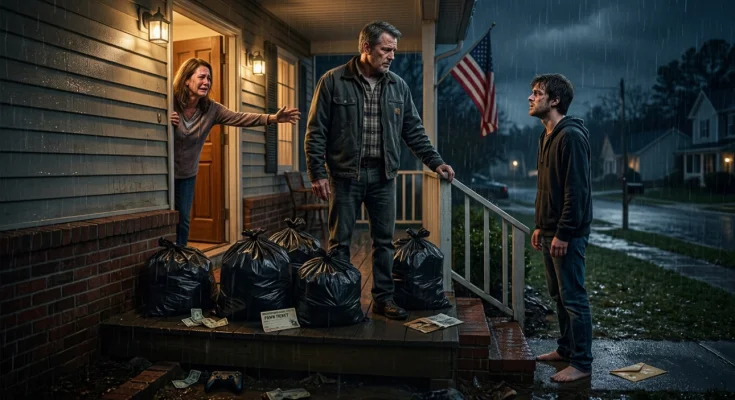
PART 5- I packed all of my 22-year-old son’s clothes into black trash bags and threw him out onto the street
Six months passed.
The quiet in our apartment stopped feeling like a void and started feeling like home again. Teresa and I spent our Tuesday evenings in a small community center basement, sitting in a circle with other parents whose children had drained their bank accounts, stolen their peace, and broken their hearts.
It was in those sessions that Teresa learned to say the hardest word in the human language to an addicted child: No.
Daniel stayed at the 4th Street facility for ninety days. It wasn’t a clean, cinematic transformation. There were phone calls during the second week where he screamed at us, accused us of abandoning him, and threatened to walk out. Every single time, Teresa held the receiver with shaking hands, listened quietly, and repeated the sentence she had rehearsed in her therapy sessions:
“We love you, Daniel, but we will not help you ruin your life. When you are ready to talk without screaming, we are here.”
By the third month, the screaming stopped.
The structure—the dawn wake-up calls, the floor scrubbing, the forced accountability, and the daily group sessions where other young men saw right through his excuses—began to strip away the toxic entitlement he had worn like armor.
On a crisp October afternoon, Daniel stood in front of the small kitchen table where his downfall had begun.
He didn’t look like the boy who had lounged on our couch demanding food. His hair was trimmed neatly, his posture was straight, and his hands were rough—calloused from working the 6:00 AM stocking shift at a local hardware store where his counselor had helped him land an entry-level job.
He didn’t sit down. He stood there, holding a small brown paper bag in his hands.
“I brought something,” he said softly, looking at Teresa.
Teresa looked at me, then at him. “Daniel, you don’t have to—”
“I do,” he interrupted, his voice firm, without a trace of his old anger.
He reached into the bag and pulled out a small, navy-blue velvet box. He placed it gently on the tablecloth, right where his unlocked phone had sat six months prior.
Teresa opened it with trembling fingers. Inside sat a pair of simple gold-plated stud earrings. They weren’t her mother’s antique heirlooms—those were gone forever, lost to the pawn shop—but they were clean, new, and paid for with honest money.
“It’s thirty percent of my first month’s paychecks,” Daniel said, looking down at his boots. “The store manager let me put them on layaway. I know it doesn’t make up for what I took… or the loans… or the way I treated you.”
He swallowed hard, his throat working as he fought back tears. For the first time in his life, he didn’t hide behind arrogance.
“I’m paying back the credit union ten dollars a week from my paycheck,” he continued, looking up at me. “And Uncle Raymond said if I keep my head straight, he’ll let me apprentice under his head mechanic starting next month.”
Teresa stood up, stepped around the table, and pulled him into her arms. Daniel hesitated for a fraction of a second—as if he felt he didn’t deserve it—before wrapping his calloused arms tightly around his mother, burying his face in her shoulder.
I didn’t join the hug. I stayed in my chair, watching my son—a real man now, carrying his own weight, owning his own mistakes, and learning the true cost of living.
When he finally pulled back, he looked at me.
“Dad,” he said quietly. “Thank you.”
“For what?” I asked softly.
“For locking the door,” Daniel replied, a small, genuine smile finally breaking across his face. “If you hadn’t left me out in the cold that night, I never would have learned how to build my own fire.”
I stood up, walked over, and extended my hand. He took it in a firm, solid grip.
The story didn’t end with a miracle. Daniel still had debts to pay, old habits to guard against, and years of trust to rebuild with us. But as we sat down to eat dinner together—a meal he helped cook and helped clean up afterward—our home felt whole again.
Not because it was perfect, but because love was finally standing on top of boundaries, where it had belonged all along.
CONTINUE READ >>>> PART 6
You may also like
Part 2- I packed all of my 22-year-old son’s clothes into black trash bags and threw him out onto the street
Part 2 Teresa lunged at me to grab the phone. With sheer desperation. “Arthur, please, don’t open it.”…
Part 3 – I packed all of my 22-year-old son’s clothes into black trash bags and threw him out onto the street
The night air at Uncle Raymond’s auto shop smelled like stale coffee, motor oil, and rusted iron. Inside…
PART 4 – I packed all of my 22-year-old son’s clothes into black trash bags and threw him out onto the street
Daniel walked into the kitchen slowly, his worn socks making a quiet dragging sound against the linoleum. He…