
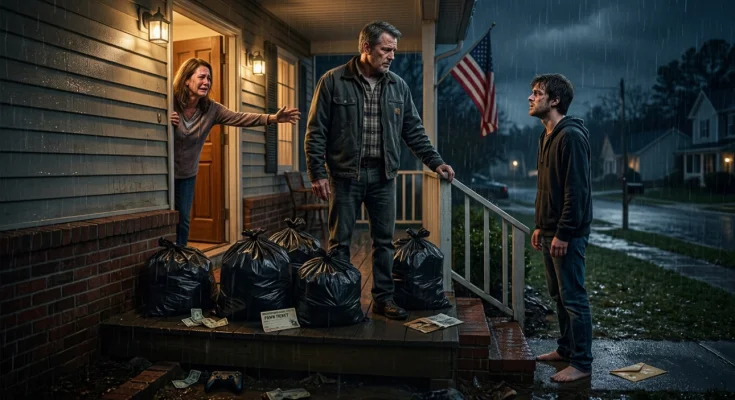
Part 3 – I packed all of my 22-year-old son’s clothes into black trash bags and threw him out onto the street
The night air at Uncle Raymond’s auto shop smelled like stale coffee, motor oil, and rusted iron. Inside the back office, the silence was heavy, broken only by the hum of an old refrigerator and the distant hiss of traffic on the rain-slicked boulevard.
I sat on a metal folding chair across from Raymond, who was nursing a mug of black coffee. Daniel was sitting on the edge of the cot in the corner, his knees pulled up to his chest, staring at his bare, dirt-smudged feet.
“He stays here tonight,” Raymond said, his voice like gravel. “Five o’clock sharp, he’s up. No excuses, no whining, no phone.”
Daniel shot Raymond a look of pure poison. “I’m not your damn laborer, Uncle Ray.”
“You aren’t anything right now, kid,” Raymond replied without raising his voice. “Except a guy sleeping on my floor because his own father couldn’t stand the sight of him under his roof.”
The words hung in the air like a slap. Daniel flinched, looking away toward the grease-stained wall.
I stood up, adjusting my jacket. My knees popped from the cold dampness that had settled into my bones. “I’m going home, Raymond. Call me if he bolts.”
“He won’t bolt,” Raymond grunted, glancing at Daniel. “He doesn’t have anywhere left to go.”
I didn’t say goodbye to Daniel. I walked out into the cool night, the heavy steel door slamming shut behind me with a finality that echoed down the alleyway.
When I walked into our apartment, Teresa was sitting at the kitchen table.
She hadn’t turned on the lights. The only illumination came from the orange glow of the streetlamp outside the window. Her face was pale, her eyes red and swollen. In front of her sat two things: Daniel’s secondary laptop charger and a small, faded photograph of him when he was five years old, wearing a yellow raincoat and holding a plastic fire truck.
“Where is he?” she whispered, her voice cracking on the second word.
“With Raymond,” I said, taking off my wet coat and hanging it on the rack by the door. “He’s sleeping on the cot in the shop.”
Teresa buried her face in her hands and began to sob—not the loud, frantic wails from earlier, but a quiet, hollow weeping that sounded far worse. “Arthur… he’s out there in the cold. What if those men come back for him? What if Matt—”
“Matt doesn’t care about Daniel,” I said, sitting across from her. “Matt cared about your credit card and my power tools. The second there was no money left, Matt threw him to the curb.”
I reached across the table and placed Daniel’s unlocked phone between us. The screen flickered with another incoming notification—a automated reminder from a digital sports betting app offering $50 in free credits if he reloaded his account.
“Look at this, Teresa,” I said softly, turning the screen toward her. “Look at what we were competing against. It wasn’t just laziness. It was a machine designed to eat him alive, and you were feeding it with your mother’s gold earrings.”
She looked at the screen, then down at her empty earlobes, her hand instinctively rising to touch her neck.
“I thought… I thought if I kept him safe at home, he’d figure it out,” she whispered, her tears dripping onto the tablecloth. “I thought if I gave him time…”
“You didn’t give him time, Teresa,” I said gently, taking her hands in mine. “You gave him shelter from reality. And reality always wins in the end.”
At four-thirty the next morning, my phone vibrated on the nightstand.
I grabbed it instantly. “Raymond?”
“He tried to lock himself in the bathroom,” Raymond said over the crackle of the line. “Told me to go to hell. I unhinged the door with a screwdriver.”
I sat up on the edge of the bed, rubbing my tired eyes. “Is he going with you?”
A brief pause on the line, followed by the sound of a heavy wooden crate banging against metal. “He’s in the passenger seat of the truck right now. Cursing up a storm, but he’s in the truck. We’re heading to the wholesale produce market.”
“Thanks, Ray.”
“Don’t thank me yet, Arthur. He looks like he wants to strangle me.”
“Let him try,” I said. “It’ll build his shoulder muscles.”
For the next three days, our house was terrifyingly quiet.
Without the constant thunder of video games from Daniel’s room, without his footfalls shaking the floorboards at two in the morning, the apartment felt vast, empty, and cold. Teresa cooked dinner out of habit, making enough for three, only to stare at the third empty plate until I quietly scraped the extra food into a Tupperware container for my lunch the next day.
On the fourth morning, Raymond called.
“He’s gone,” Raymond said plainly.
My heart sank. “What do you mean?”
“Worked two shifts at the market, picked up his seventy bucks in cash from the vendor, walked out at noon, and didn’t come back to the shop tonight. Left his trash bag of clothes behind.”
I closed my eyes, a heavy, dull ache settling deep behind my ribs. “Did he say anything?”
“Said he wasn’t born to haul potatoes,” Raymond replied. “Told me he had ‘projects’ to attend to.”
When I told Teresa, she collapsed onto the sofa. “We lost him,” she whispered. “He’s back on the street.”
“No,” I said, standing by the window and watching the morning traffic crawl down our street. “He’s not lost. He knows where we live. He knows where Raymond’s shop is. He knows the way back—he just wants to see if we’ll break first.”
“Arthur, please—”
“No, Teresa!” I turned around, my voice firm. “We do not call him. We do not search the neighborhood. We do not transfer fifty dollars to his CashApp. If he wants a life, he has to choose it himself.”
Forty-eight hours passed. Two days of agonizing, suffocating uncertainty.
On the sixth night after I threw him out, the doorbell rang.
It wasn’t a sharp, demanding ring like Daniel usually gave when he forgot his keys. It was a single, hesitant buzz.
Teresa sprinted to the door, but I caught her arm gently, holding her back. “Remember,” I reminded her softly. “Boundaries.”
She swallowed hard, wiped her palms on her apron, and nodded.
I opened the door.
Daniel stood in the hallway under the flickering fluorescent light.
His clothes were filthy, stained with street grease and rain. His eyes were sunken, dark circles carved deep into his skin, and he smelled faintly of sour sweat and exhaust fumes. He wasn’t wearing shoes—just thick, black work socks pulled over his feet, the soles worn completely through, exposing dirty gray toes.
He didn’t look angry anymore. He just looked exhausted.
He stood there for five long seconds, staring at the doormat.
“I’m hungry,” he said quietly.
No grand speeches. No apologies. Just the raw, primitive truth of a human being who had run out of options.
Teresa made a move to rush forward, but I stepped slightly in front of her, keeping my frame in the doorway.
“There’s hot stew on the stove,” I said, my voice quiet, even, and unyielding. “You can come in, eat a bowl, and wash your face in the bathroom.”
Daniel looked up, a tiny spark of his old entitlement flaring in his eyes. “And then?”
“And then,” I said, “I drive you to the community intake center on 4th Street. They have a bed, a counselor who specializes in gambling debts, and a program that helps young men find actual employment.”
“A shelter?” Daniel scoffed, a bitter, trembling laugh escaping his lips. “You’re sending your own son to a shelter?”
“I’m offering you a ladder out of the pit you dug,” I replied, looking him squarely in the eye. “You can take my hand and climb out, or you can turn around and walk back down those stairs. But you are not sleeping in that bedroom again until you pay back every dollar you stole from your mother.”
Daniel looked past me at Teresa.
For twenty-two years, that look had been his ultimate weapon. Every time he looked at her with those wounded, pathetic eyes, she had caved. She had paid his debts, ironed his shirts, lied to me, and protected him from the world.
He waited for her to step past me. He waited for her to say, “Arthur, stop, he’s our boy.”
Teresa looked at him. Her eyes overflowed with tears, her chin trembled, and her hands shook violently at her sides.
Then, slowly, deliberately, she took one step backward, placing her hand gently on my shoulder.
“Listen to your father, Daniel,” she choked out, her voice barely above a whisper. “We love you… but we can’t save you anymore.”
Daniel froze.
The last shield had fallen. The weapon was broken.
He looked at his torn socks on the cold hallway floor. He looked at my face, then at his mother’s. The arrogance that had coated him for years dissolved right there in the dim light of the apartment corridor, leaving behind only the scared, lost kid who had let the world swallow him whole.
Slowly, his shoulders slumped. He let out a long, ragged exhale that sounded like a deflating balloon.
“Is the stew still warm?” he asked softly.
“It is,” I said.
I stepped aside and opened the door wider, letting my son enter our home—not as a prince demanding a tribute, but as a man finally ready to learn how to ask for help.
CONTINUE READ >>>> PART 4
You may also like
Part 2- I packed all of my 22-year-old son’s clothes into black trash bags and threw him out onto the street
Part 2 Teresa lunged at me to grab the phone. With sheer desperation. “Arthur, please, don’t open it.”…
PART 4 – I packed all of my 22-year-old son’s clothes into black trash bags and threw him out onto the street
Daniel walked into the kitchen slowly, his worn socks making a quiet dragging sound against the linoleum. He…
PART 5- I packed all of my 22-year-old son’s clothes into black trash bags and threw him out onto the street
Six months passed. The quiet in our apartment stopped feeling like a void and started feeling like home…
One Comment on “Part 3 – I packed all of my 22-year-old son’s clothes into black trash bags and threw him out onto the street”