
My daughter texted me on December 20th: “Mom, we decided Christmas is immediate family only this year. Hope you understand.” I wrote back one word: “Understood.” Then I mailed each of my grandkids a letter. Not a gift. A letter. On Christmas morning at 9 a.m., two kids showed up at my door on their bikes in the snow. Their mother’s car pulled in four minutes later.
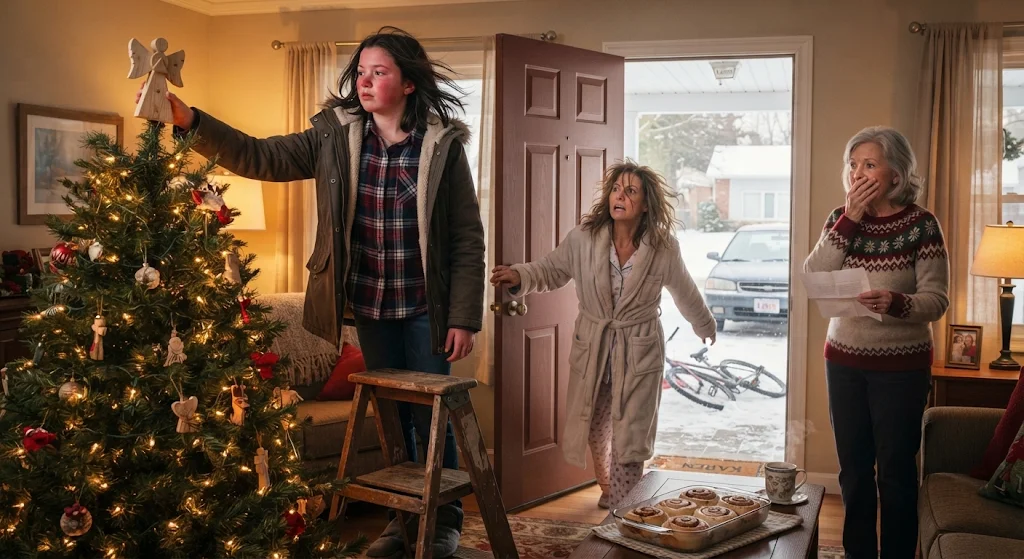
Lucy stood on the little wooden step stool, one hand resting against the Christmas tree.
Her cheeks were still red from the cold.
Her brown hair hung loose over her pajamas, and she was clutching the envelope I’d sent her so tightly that its edges had begun to curl.
Then she looked straight at her mother.
“Grandma didn’t tell us to come, Mom.”
Karen stopped in the middle of my living room.
“What?”
Lucy climbed down from the stool.
“She didn’t ask us to leave your house. She didn’t say anything bad about you or Dad. She just told us she loved us.”
Karen opened her mouth.
But Lucy wasn’t finished.
“She told me the angel was waiting for me.”
Her voice trembled.
“And yesterday, when I asked if we were going to Grandma’s house, you said Grandma didn’t want to do Christmas this year.”
I felt something tighten painfully beneath my ribs.
Karen’s face went pale.
“Lucy, that’s not what I—”
“Yes, it is,” Lucy interrupted. “You said Grandma was getting older and wanted a quiet holiday.”
Behind Karen, I saw Ted step out of the car.
His parents were still sitting in their silver sedan at the end of my driveway.
The engine was running.
Snow gathered along the windshield.
Karen reached toward Lucy.
“Honey, let’s talk about this at home.”
Lucy stepped backward.
“No.”
It wasn’t loud.
It wasn’t disrespectful.
But it was the kind of no that made every adult in the room understand that something important had changed.
Then my twelve-year-old granddaughter said the words I would remember for the rest of my life.
“Mom, you keep saying Christmas is about family. But every time you say ‘family,’ you mean Grandma isn’t part of it.”
The room fell silent.
From the kitchen, Sam called out, “Grandma, are the cinnamon rolls done?”
Nobody answered him.
Ted had reached the front porch.
He was wearing jeans, house slippers, and a winter coat thrown over his T-shirt.
He looked from Karen to Lucy.
Then to me.
“What’s going on?”
Karen spun toward him.
“Your children rode their bikes through the snow without telling us!”
My stomach tightened.
She was right about that.
Whatever hurt I was feeling, two children riding bicycles on icy roads in freezing weather was dangerous.
I looked toward Lucy.
“Sweetheart, you and Sam should never have come here without telling your parents. You could have been hurt.”
Lucy’s eyes filled.
“But Grandma—”
“I know, darling. I know why you came. But next time, you call me, and we’ll find a safe way.”
She nodded.
Then she looked down at the letter.
“I just didn’t want you to be alone.”
And that was when I nearly broke.
***
My name is Evelyn Mercer.
I’m seventy-two years old.
For forty-one years, Christmas morning in my house had begun the same way.
My husband, George, would wake before sunrise, turn on the tree lights, and start the coffee.
I would make cinnamon rolls from the recipe his mother had taught me during our first year of marriage.
At eight o’clock, the kitchen would smell like butter, cinnamon, and warm sugar.
By nine, somebody would be laughing.
By ten, there would be wrapping paper everywhere.
When our daughter Karen was little, she’d sit on the kitchen counter and steal pieces of dough.
When she married Ted, we simply added another chair.
When Ben was born, George bought a little wooden train to place beneath the tree.
When Lucy arrived, I bought the carved angel.
And when Sam was born, George built a small wooden sled, painted it bright red, and wrote his grandson’s name underneath.
Christmas wasn’t about expensive presents.
It was about the little things that stayed the same while everything else changed.
Then George died.
Four years before that snowy morning, a heart attack took him while he was trimming the roses in our backyard.
He was seventy-four.
We’d been married forty-eight years.
After the funeral, Karen told me I shouldn’t spend Christmas alone.
“Mom, the holidays are still yours,” she said. “We’ll always come.”
And for three years, they did.
But slowly, things began changing.
Ted’s parents, Richard and Elaine, retired and moved closer.
They had always preferred expensive restaurants, elaborate decorations, and the kind of Christmas dinners that looked as though they belonged in a magazine.
I had nothing against that.
People celebrated differently.
But Richard could make a person feel small without ever raising his voice.
Last Christmas, he took one bite of my glazed ham and said, “Well, I suppose you can’t expect restaurant quality from home cooking.”
Elaine laughed.
Ted pretended he hadn’t heard.
Karen told me afterward that I shouldn’t take everything so personally.
I didn’t argue.
I packed the leftovers and washed the dishes.
But that evening, standing alone at my kitchen sink, I wondered when my home had stopped feeling like a place where I was respected.
Still, I never imagined Karen would decide I wasn’t immediate family.
Not until December 20.
***
Ted finally entered the living room.
He looked at the tree, the cinnamon-scented air, and the three stockings hanging from the mantel.
Then his gaze fell on the wooden angel.
Lucy had placed it exactly where she’d always placed it.
At the very top.
“What letters?” he asked.
Karen gave me an accusing look.
“Mom mailed things to the children behind our backs.”
I took a steady breath.
“I mailed my grandchildren Christmas letters.”
“What did they say?” Ted asked.
I walked to my writing desk.
The drafts were still there.
I had kept copies because my handwriting wasn’t as steady as it used to be, and I’d wanted to make sure each letter was legible.
I handed them to him.
Ted read Ben’s first.
Then Lucy’s.
Then Sam’s.
His expression slowly changed.
He looked at Karen.
“These are just memories.”
Karen folded her arms.
“She knew exactly what she was doing.”
I looked at my daughter.
“No, Karen. I didn’t know what would happen. I thought the children might enjoy receiving something personal in the mail.”
“You deliberately went around me.”
“I didn’t ask them to come.”
“You told them the door was unlocked!”
“That was careless wording on my part, and I regret it. I should have made clear they needed your permission and a safe ride.”
Karen looked momentarily surprised.
She hadn’t expected me to acknowledge that.
Then I continued.
“But you told them I didn’t want to celebrate Christmas.”
Karen stared at me.
“I was trying to avoid upsetting them.”
“By making them think I didn’t want to see them?”
She looked away.
That hurt more than I expected.
Because it meant she’d understood exactly what she’d been doing.
She simply hadn’t expected anyone to question her.
***
Ben appeared at the doorway a moment later.
He was fourteen, tall and lanky, with George’s serious eyes.
He had apparently walked from Karen’s car after hearing the argument.
“Grandma?”
I smiled through my tears.
“Hello, sweetheart.”
He crossed the room and hugged me.
A proper hug.
Not the quick, embarrassed kind teenagers sometimes give.
He held on.
“I’m sorry,” he whispered.
I pulled back.
“What are you apologizing for?”
“Mom said you didn’t want visitors. I thought maybe you didn’t want us anymore.”
My throat tightened.
“Oh, Benjamin.”
I cupped his face.
You may also like
PART >> 3 My daughter texted me on December 20th: “Mom, we decided Christmas is immediate family only this year. Hope you understand.” I wrote back one word: “Understood.” Then I mailed each of my grandkids a letter. Not a gift. A letter. On Christmas morning at 9 a.m., two kids showed up at my door on their bikes in the snow. Their mother’s car pulled in four minutes later.
“There is nothing in this world that would make me stop wanting to see you.” He nodded. Then…
PART >> 4 My daughter texted me on December 20th: “Mom, we decided Christmas is immediate family only this year. Hope you understand.” I wrote back one word: “Understood.” Then I mailed each of my grandkids a letter. Not a gift. A letter. On Christmas morning at 9 a.m., two kids showed up at my door on their bikes in the snow. Their mother’s car pulled in four minutes later.
All designed to spare her the discomfort of a difficult conversation. “I thought we’d visit in January,” she…
PART >> 5 (END) My daughter texted me on December 20th: “Mom, we decided Christmas is immediate family only this year. Hope you understand.” I wrote back one word: “Understood.” Then I mailed each of my grandkids a letter. Not a gift. A letter. On Christmas morning at 9 a.m., two kids showed up at my door on their bikes in the snow. Their mother’s car pulled in four minutes later.
A proper place. Beside Lucy. With a handwritten card. GRANDMA. I stopped walking. For a moment, all I…