
PART >> 5 (END) My daughter texted me on December 20th: “Mom, we decided Christmas is immediate family only this year. Hope you understand.” I wrote back one word: “Understood.” Then I mailed each of my grandkids a letter. Not a gift. A letter. On Christmas morning at 9 a.m., two kids showed up at my door on their bikes in the snow. Their mother’s car pulled in four minutes later.
A proper place.
Beside Lucy.
With a handwritten card.
GRANDMA.
I stopped walking.
For a moment, all I could do was stare.
Then Sam ran toward me.
“Grandma! We saved your seat!”
I bent down and hugged him.
“Thank you, sweetheart.”
Lucy took my hand.
“Come see.”
She led me toward the fireplace.
On the mantel stood a small photograph of George.
It had been taken one Christmas morning years earlier.
He was standing in our kitchen wearing a ridiculous red apron, holding a tray of cinnamon rolls.
I looked at Karen.
She smiled through tears.
“I found it in an old album. I thought Grandpa should be here too.”
I pressed a hand to my chest.
For the first time that day, I couldn’t speak.
***
Dinner wasn’t perfect.
The potatoes were slightly undercooked.
Ted dropped a serving spoon.
Richard complained that the gravy was too thick, then stopped when Ted gave him a pointed look.
Elaine quietly asked me for the cinnamon roll recipe.
I gave it to her.
Because I wasn’t interested in winning a competition.
I was interested in having a family.
Halfway through dinner, Ben tapped his glass with a spoon.
Everyone turned toward him.
He looked embarrassed.
“I just want to say something.”
Ted smiled.
“Go ahead, buddy.”
Ben looked at me.
“Grandma, I read your letter like five times.”
I laughed softly.
“Five?”
He nodded.
“You wrote that Grandpa taught you how to make Christmas feel like home.”
I smiled.
“Yes.”
Ben swallowed.
“And you said you hoped we’d always remember that Christmas wasn’t about where we ate dinner.”
My throat tightened.
He looked around the table.
“I think we forgot that.”
Nobody spoke.
Then Lucy reached for my hand.
“Not anymore.”
Sam nodded enthusiastically.
“Yeah. Grandma has the best cinnamon rolls anyway.”
Everyone laughed.
Even Richard.
And just like that, something heavy lifted from the room.
***
In January, Karen came over one Sunday afternoon.
Alone.
No Ted.
No children.
Just my daughter.
She brought soup and a loaf of fresh bread.
We sat at my kitchen table for nearly three hours.
We talked about ordinary things first.
The weather.
Ben’s basketball games.
Lucy’s school project.
Sam’s missing front tooth.
Then Karen began telling me how overwhelmed she’d been trying to please everyone.
She admitted she’d become so afraid of conflict with Ted’s parents that she had started sacrificing the easiest relationship in her life.
Ours.
“I always thought you’d understand,” she said.
I stirred my tea.
“Because I usually did.”
She nodded.
“And because you never made me feel guilty.”
I looked at her.
“Maybe I should have told you sooner when something hurt.”
Karen shook her head.
“No, Mom. You shouldn’t have to teach me basic kindness.”
I smiled faintly.
“Well, we all need reminders sometimes.”
She reached across the table.
“Can we make a new rule?”
“What kind?”
“No more decisions about holidays without talking to each other first.”
I considered that.
“That sounds reasonable.”
“And no more telling people what someone else wants without asking them.”
I laughed softly.
“That sounds even better.”
***
The months passed.
Spring came.
Then summer.
The children visited often.
Ben helped me repair the fence.
Lucy spent Saturday afternoons baking beside me.
Sam insisted that George’s little red sled needed repainting, even though he was far too big to ride it anymore.
One afternoon, while we were working in the backyard, Lucy asked something that made me stop.
“Grandma, were you really going to spend Christmas alone?”
I looked at her.
“Yes, sweetheart.”
She frowned.
“But why didn’t you just come to our house?”
I knelt beside her.
“Because your mother had told me the celebration was only for certain people.”
Lucy thought about that.
Then she said, “But you’re certain people.”
I laughed.
“Am I?”
She nodded fiercely.
“You’re Grandma.”
I hugged her.
And I realized something important.
Children often understand belonging far more clearly than adults do.
They don’t usually care who owns the biggest house.
Who prepares the fanciest dinner.
Who has the nicest decorations.
They remember who shows up.
Who listens.
Who remembers their favorite stories.
Who makes them feel safe.
And sometimes, they notice when an adult is missing long before anyone else admits it.
***
The following December, Karen called me on the first.
Not the twentieth.
The first.
“Mom, we’ve been talking about Christmas.”
I smiled.
“Have you?”
“Yes. And we wanted to ask what you’d like to do.”
I looked out the kitchen window.
Snow was beginning to gather along the fence.
For forty-one years, I’d hosted Christmas.
And for the first time in my life, someone was asking what I wanted.
I thought about it.
Then I said, “I’d like Christmas morning here. Cinnamon rolls, coffee, and the children opening one gift each.”
Karen laughed.
“That sounds wonderful.”
“And Christmas dinner at your house, if that’s what you prefer.”
“Perfect.”
I hesitated.
“Karen?”
“Yes, Mom?”
“Thank you for asking.”
Her voice softened.
“I should have been asking all along.”
***
Christmas morning arrived clear and cold.
At seven fifty-five, I heard a car pull into the driveway.
Not bicycles.
A car.
Ted had driven the children over himself.
Karen climbed out carrying a casserole dish.
Ben carried a stack of board games.
Lucy held a little wrapped package.
And Sam came running toward the porch before anyone could stop him.
“GRANDMA!”
I opened the door.
He threw his arms around me.
“Are the cinnamon rolls ready?”
I laughed.
“Almost.”
He grinned.
“It smells right.”
Those three words brought tears to my eyes.
The same words he’d spoken the year before.
When he’d arrived on his bicycle with snow in his hair and fear in his heart.
Only this time, nobody was frightened.
Nobody was hiding.
Nobody had been made to feel unwanted.
Everyone had been invited.
***
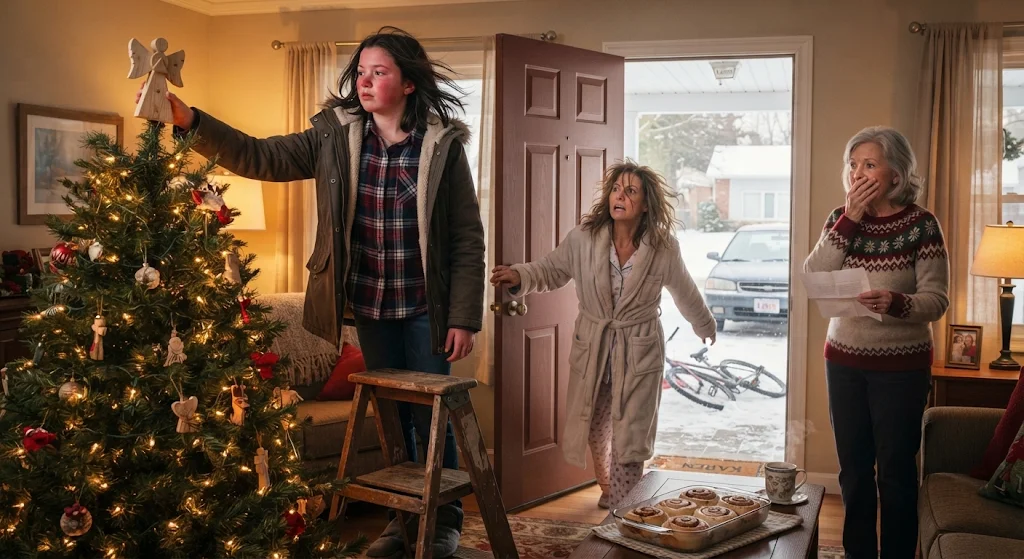
Later that morning, Lucy placed her wooden angel on top of the tree.
She was getting taller now.
She barely needed the step stool.
Ben stood nearby, pretending he wasn’t interested.
Sam sat on the carpet playing with George’s wooden train.
Karen stood beside me.
For a moment, we simply watched them.
Then she whispered, “Mom?”
“Yes?”
“I still think about those letters.”
I smiled.
“So do I.”
She looked at me.
“I was angry when I first saw them.”
“I know.”
“I thought you were trying to turn my children against me.”
I shook my head.
“I would never do that, Karen.”
“I know that now.”
She paused.
“But the truth is, they weren’t angry because of anything you wrote.”
I looked at her.
“They were hurt because they knew something was missing.”
We stood quietly.
Then Karen slipped her arm around my shoulders.
“I’m glad they came that morning.”
I rested my head against hers.
“I’m glad they came safely through it. But I hope they never do anything like that again.”
Karen laughed softly.
“Believe me. We’ve had that conversation.”
Then she kissed my cheek.
“Merry Christmas, Mom.”
“Merry Christmas, sweetheart.”
***
I’m seventy-three now.
I still make cinnamon rolls every Christmas morning.
I still use George’s old mixing bowl.
And I still keep the wooden angel in its little box until Lucy arrives.
But something changed after that Christmas.
I stopped believing that keeping the peace meant quietly accepting being left out.
And Karen learned that protecting someone from an uncomfortable conversation isn’t the same thing as treating them with love.
Sometimes, honesty is uncomfortable.
Sometimes, families have to make room for new traditions.
And sometimes, the people who have always been there need to say, gently but clearly, that they want to belong too.
I never wanted my grandchildren to choose between their parents and me.
I never wanted them to ride through snow to prove their love.
I only wanted them to know that my door was open, my heart was open, and the traditions we’d built together were still theirs to remember.
The letters weren’t meant to start a fight.
They were meant to preserve a memory.
But they revealed something none of us could ignore.
Love isn’t measured by the size of a Christmas dinner.
It isn’t measured by who has the most expensive decorations or the prettiest table.
And it certainly isn’t measured by who gets to decide which relatives count as immediate family.
Love is measured in the moments we make room for one another.
In the phone calls we remember to make.
In the chairs we set around our tables.
In the small wooden angels we save for little hands.
And in the cinnamon rolls that make a house smell like home.
That Christmas, my daughter told me I wasn’t immediate family.
One year later, she handed me a place card with a single word written across it.
MOM.
And somehow, that one word meant more than any present beneath the tree.
Because I wasn’t asking to be the center of Christmas.
I never had been.
I just wanted to know there was still a place for me in the family I’d spent my life loving.
And finally, there was.
THE END
You may also like
My daughter texted me on December 20th: “Mom, we decided Christmas is immediate family only this year. Hope you understand.” I wrote back one word: “Understood.” Then I mailed each of my grandkids a letter. Not a gift. A letter. On Christmas morning at 9 a.m., two kids showed up at my door on their bikes in the snow. Their mother’s car pulled in four minutes later.
Lucy stood on the little wooden step stool, one hand resting against the Christmas tree. Her cheeks were…
PART >> 3 My daughter texted me on December 20th: “Mom, we decided Christmas is immediate family only this year. Hope you understand.” I wrote back one word: “Understood.” Then I mailed each of my grandkids a letter. Not a gift. A letter. On Christmas morning at 9 a.m., two kids showed up at my door on their bikes in the snow. Their mother’s car pulled in four minutes later.
“There is nothing in this world that would make me stop wanting to see you.” He nodded. Then…
PART >> 4 My daughter texted me on December 20th: “Mom, we decided Christmas is immediate family only this year. Hope you understand.” I wrote back one word: “Understood.” Then I mailed each of my grandkids a letter. Not a gift. A letter. On Christmas morning at 9 a.m., two kids showed up at my door on their bikes in the snow. Their mother’s car pulled in four minutes later.
All designed to spare her the discomfort of a difficult conversation. “I thought we’d visit in January,” she…
One Comment on “PART >> 5 (END) My daughter texted me on December 20th: “Mom, we decided Christmas is immediate family only this year. Hope you understand.” I wrote back one word: “Understood.” Then I mailed each of my grandkids a letter. Not a gift. A letter. On Christmas morning at 9 a.m., two kids showed up at my door on their bikes in the snow. Their mother’s car pulled in four minutes later.”