
PART >> 4 My daughter texted me on December 20th: “Mom, we decided Christmas is immediate family only this year. Hope you understand.” I wrote back one word: “Understood.” Then I mailed each of my grandkids a letter. Not a gift. A letter. On Christmas morning at 9 a.m., two kids showed up at my door on their bikes in the snow. Their mother’s car pulled in four minutes later.
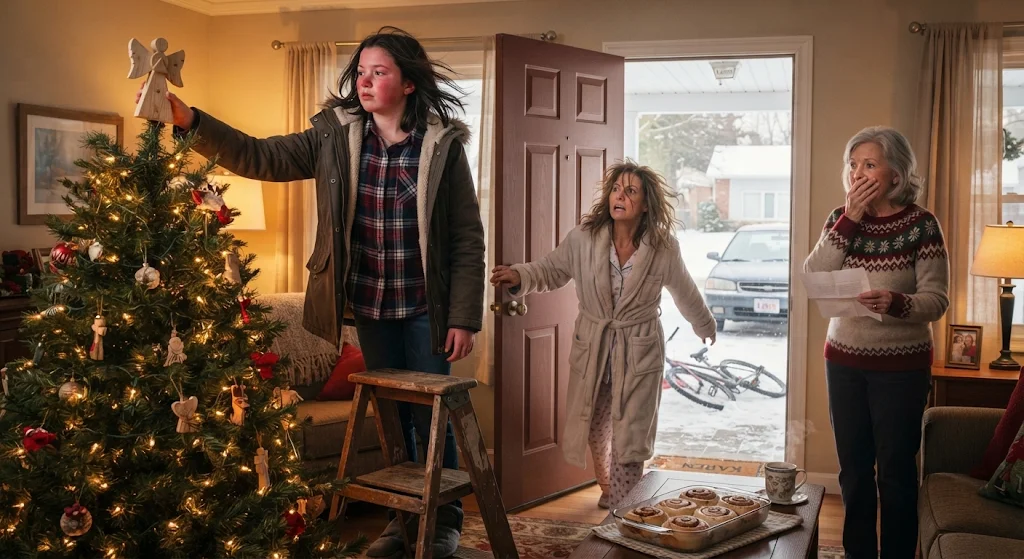
All designed to spare her the discomfort of a difficult conversation.
“I thought we’d visit in January,” she whispered.
I looked at her.
“Karen, you weren’t rescheduling a dentist appointment.”
Her chin trembled.
“You were telling your mother that she didn’t belong at Christmas.”
She began crying.
“I know.”
“No, sweetheart. I don’t think you understood until now.”
***
The cinnamon rolls were cooling on the kitchen counter.
I could smell the familiar butter and brown sugar.
Sam had finished two.
Lucy was sitting beside Ben, both looking exhausted.
And suddenly, I realized the adults were turning Christmas into a courtroom while the children sat listening.
I stood.
“Enough for now.”
Everyone looked at me.
I turned toward Karen and Ted.
“The children need breakfast. Then you two need to decide how you’re spending the day.”
Karen wiped her eyes.
“Mom—”
“I’m not sending anyone away. But I won’t have the children sitting here while we keep arguing.”
Ted nodded.
“You’re right.”
He looked at Ben, Lucy, and Sam.
“Kids, we’re sorry. We should have explained our plans honestly, and we were wrong to leave you confused.”
Then he crouched beside Lucy.
“And you two are never riding bikes in the snow like that again. Do you understand?”
Lucy nodded.
“We just wanted to see Grandma.”
“I know,” Ted said. “But you could have been seriously hurt.”
Sam looked worried.
“Are we in trouble?”
Ted sighed.
“We’ll talk about the rules later. Right now, I’m glad you’re safe.”
I appreciated that.
Because loving the children didn’t mean pretending their decision had been safe.
And correcting them didn’t mean ignoring why they’d felt so desperate to come.
***
By eleven o’clock, something unexpected happened.
Ted asked whether everyone could stay for breakfast.
I almost laughed.
Breakfast.
My kitchen had enough cinnamon rolls to feed a small church.
I’d made them out of habit, because for forty-one years, Christmas morning had meant feeding a house full of people.
“There’s coffee,” I said. “And enough food.”
Ted smiled.
“Then we’d love to stay.”
Richard looked as though he wanted to object.
But Elaine touched his arm.
And for once, he remained silent.
I brought out plates.
Ben poured orange juice.
Lucy arranged the cinnamon rolls on my old green serving platter.
Sam insisted on carrying the napkins, dropping half of them along the way.
And slowly, the house began to sound like Christmas again.
Not because everything had been fixed.
It hadn’t.
But because the children were laughing.
And I had missed that sound more than I could explain.
***
After breakfast, Karen found me alone in the kitchen.
I was rinsing a mixing bowl.
She stood in the doorway for a long moment.
Then she said, “Mom, can we talk?”
I dried my hands.
“Of course.”
She approached the counter.
Her face was swollen from crying.
“I didn’t realize how cruel that text sounded until Lucy read it out loud.”
I nodded.
“Sometimes words look different when someone else has to hear them.”
She began crying again.
“I thought you’d understand.”
I looked at my daughter.
“Karen, I’ve spent your whole life trying to understand.”
She lowered her eyes.
“When you were little, I understood that you needed more attention than the housework.”
I smiled sadly.
“When you were a teenager, I understood that you wanted your friends more than your mother.”
Her lips trembled.
“When you married Ted, I understood that your family would grow and your priorities would change.”
I paused.
“But I never imagined I’d have to understand being deliberately left out of Christmas while everyone else celebrated together.”
Karen wiped her cheeks.
“I’m sorry.”
I nodded.
“Thank you.”
She reached for my hand.
“Can you forgive me?”
I thought about the text.
December 20.
Immediate family only.
Hope you understand.
I thought about the quiet house.
The letters.
The angel waiting in its box.
Then I looked at Karen.
“I love you. And I want us to rebuild from this. But I need you to stop confusing my willingness to understand with a willingness to be hurt.”
She began crying harder.
“I don’t know how to stand up to everyone.”
“Then that’s something you need to learn.”
She nodded.
“I know.”
“Because someday, Ben and Lucy and Sam will be grown.”
Her eyes met mine.
“They’ll have spouses. Children. In-laws. Complicated schedules.”
I squeezed her hand.
“And when that happens, I hope they never make you feel like loving you is an inconvenience.”
Karen covered her mouth.
For the first time that morning, she seemed to understand what she’d done.
Not merely that she’d upset me.
But that she’d taught her children something painful about how families treat the people who grow older.
***
Around noon, Ted came into the kitchen.
He looked at Karen.
Then at me.
“Evelyn, I’d like to apologize.”
I was surprised.
He continued.
“I should have checked with you directly about Christmas. I let Karen handle the invitations because she’s always organized family gatherings.”
I nodded.
“That was understandable.”
“But I also heard my parents making comments about your cooking and your house last year, and I didn’t say anything.”
I looked at him.
He swallowed.
“That was wrong.”
I hadn’t expected him to mention it.
“Thank you, Ted.”
He glanced toward the living room.
“Dad can be difficult.”
“Yes,” I replied. “He can.”
Ted gave an embarrassed smile.
Then he grew serious.
“I’m not asking you to forget what happened. But would you consider coming to our house for dinner tonight?”
I hesitated.
Karen looked hopeful.
I thought about the little ham I’d planned to warm for myself.
The pie cooling on the counter.
The Christmas movie I’d planned to watch alone.
Then I looked toward the living room.
Ben was helping Sam put the wooden train back on its track.
Lucy was sitting beneath the tree, looking up at her angel.
I realized something.
I didn’t want to spend Christmas proving a point.
I wanted to spend it with people who genuinely wanted me there.
“If I’m invited because you want me,” I said, “I’d love to come.”
Ted smiled.
“We do.”
Karen nodded quickly.
“We really do.”
I held up one finger.
“But no one is going to criticize my ham.”
Ted laughed.
“Agreed.”
***
That afternoon, I drove to Karen and Ted’s house.
I brought the pecan pie I’d made the night before.
And I brought George’s old carving knife.
Not because anyone had asked me to.
Because Ted called and said he wanted me to teach him how George used to carve the Christmas ham.
When I walked inside, the house was warm and bright.
The children had changed into their Christmas sweaters.
A fire burned in the fireplace.
And there was a place set for me at the dining table.
Not squeezed into a corner.
Not added at the last minute with a mismatched chair.
You may also like
My daughter texted me on December 20th: “Mom, we decided Christmas is immediate family only this year. Hope you understand.” I wrote back one word: “Understood.” Then I mailed each of my grandkids a letter. Not a gift. A letter. On Christmas morning at 9 a.m., two kids showed up at my door on their bikes in the snow. Their mother’s car pulled in four minutes later.
Lucy stood on the little wooden step stool, one hand resting against the Christmas tree. Her cheeks were…
PART >> 3 My daughter texted me on December 20th: “Mom, we decided Christmas is immediate family only this year. Hope you understand.” I wrote back one word: “Understood.” Then I mailed each of my grandkids a letter. Not a gift. A letter. On Christmas morning at 9 a.m., two kids showed up at my door on their bikes in the snow. Their mother’s car pulled in four minutes later.
“There is nothing in this world that would make me stop wanting to see you.” He nodded. Then…
PART >> 5 (END) My daughter texted me on December 20th: “Mom, we decided Christmas is immediate family only this year. Hope you understand.” I wrote back one word: “Understood.” Then I mailed each of my grandkids a letter. Not a gift. A letter. On Christmas morning at 9 a.m., two kids showed up at my door on their bikes in the snow. Their mother’s car pulled in four minutes later.
A proper place. Beside Lucy. With a handwritten card. GRANDMA. I stopped walking. For a moment, all I…