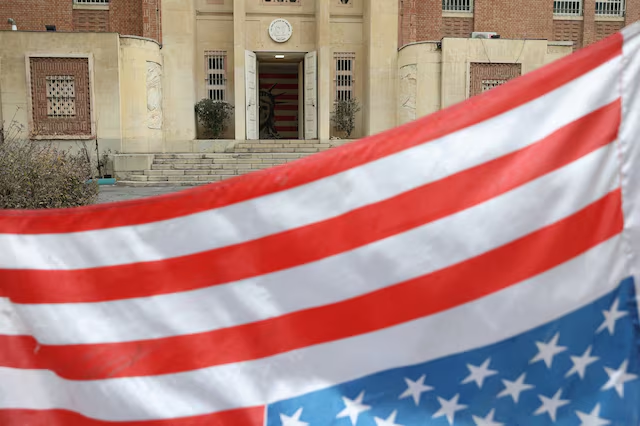
In early 2026, tensions between the United States and the Islamic Republic of Iran reached a level not seen in years — raising international concern about the possibility of direct conflict between two major powers in the Middle East.
Background: A Long-Standing Rivalry
The U.S. and Iran have been geopolitical adversaries for decades, with disagreements ranging from Iran’s nuclear programme and regional influence to support for militant groups and broader security interests. Previous military confrontations have included incidents such as the 1998 Operation Praying Mantis, a naval engagement between U.S. and Iranian forces in the Persian Gulf, and multiple clashes involving proxy groups in Iraq and Syria.
Since mid-2025, tensions spiked further after U.S. and Israeli strikes damaged several Iranian nuclear facilities, prompting Iran to vow retaliation and marking one of the most direct uses of force against Iranian territory in years.
Current Buildup: Military Posture and Diplomacy
As of February 2026, the United States has significantly increased its military presence in the Middle East. According to U.S. officials, the Pentagon is preparing for potential sustained military operations that could last several weeks if ordered by President Donald Trump. This buildup includes aircraft carriers, fighter jets, missile destroyers, and thousands of additional troops.
President Trump has also sent a second aircraft carrier — the USS Gerald R. Ford — to join the USS Abraham Lincoln in the region as pressure grows on Tehran to accept stricter limits on its nuclear programme and other military capabilities.
Iran’s Response and Warnings
Iranian leaders have issued stark warnings that any U.S. attack would be treated as a declaration of war:
-
Iran’s Supreme Leader Ayatollah Ali Khamenei has said that a U.S. strike would trigger a regional war across the Middle East, escalating beyond a bilateral conflict.
-
Senior Iranian officials have declared that any form of attack — whether limited or broad — would be seen as all-out war, implying robust retaliation.
-
Tehran has also warned it could target American military bases in the region if Washington initiates strikes.
Diplomatic efforts continue in parallel, with countries like Turkiye attempting to mediate discussions and reduce the risk of outright conflict.
Diplomacy vs. Escalation
Despite military tensions, diplomats from both sides have engaged in talks, including indirect negotiations held recently in Oman to address nuclear and regional security issues, though progress has been limited. Some nations in the region — particularly Gulf Arab states — are urging restraint to avoid full-scale war.
However, analysts warn that miscalculations on either side could rapidly escalate the situation into open hostilities with broader regional consequences.
Global Stakes
A direct conflict between the U.S. and Iran would not only reshape power balances in the Middle East but could also affect global markets, especially oil prices, and draw in other world powers with vested interests in the region’s stability.
If you’d like, I can also provide a timeline of recent events between the U.S. and Iran or explain the potential global consequences of such a conflict in more detail.