That summer evening in Central Park, the sunlight slid lazily through the trees, and the park hummed with distant music, laughter, and the sweet scent of grass and street food.
Daniel Foster moved carefully as he pushed the wheelchair forward, as if the ground itself resisted him. He was a man accustomed to influence—boardrooms fell silent when he spoke, contracts bent in his favor—but here, none of that power mattered.
In the chair sat his seven-year-old son, Ethan.
There was nothing physically wrong with Ethan’s legs. No fractures. No neurological damage. Every scan came back clean.
Yet after Ethan’s mother vanished without explanation, the boy had simply stopped walking. Then, piece by piece, he stopped engaging with the world at all.
Daniel had chased solutions across continents—elite doctors, private clinics, experimental therapies. He filled the house with toys, tutors, and distractions. Still, the silence followed them everywhere, echoing in the halls, trailing the soft roll of the wheelchair like an admission of defeat.
A specialist suggested exposure. Community. Human connection.
So Daniel brought Ethan to a charity event in the park.
Children ran past them, shouting, tumbling, living. Ethan stared straight ahead, unmoved.
Then someone stepped into their path.
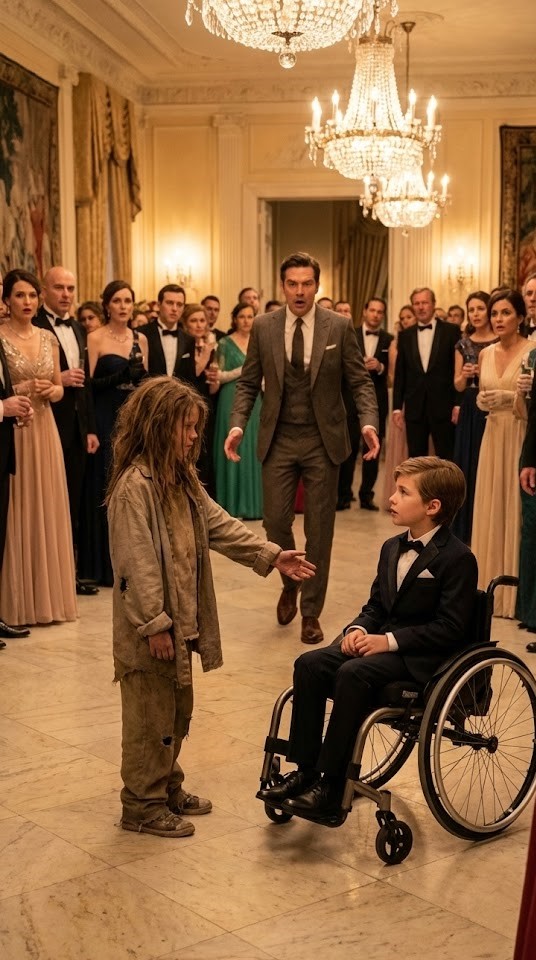
A barefoot girl stood in front of the wheelchair. Her clothes were frayed, her hair knotted by neglect, but her eyes were steady—unafraid, almost luminous.
“Hi,” she said—not to Daniel, but to Ethan, as if the wheelchair didn’t exist.
Daniel stiffened. Experience had taught him to expect requests, schemes, pity.
The girl leaned closer and spoke softly.
“Let me dance with your son. I’ll help him walk.”
Daniel’s patience snapped. “Move away,” he said sharply.
Before he could say more, Ethan turned his head.
Really turned.
His gaze locked onto the girl’s face.
She knelt to his level and smiled. “I know what you’re going through,” she whispered. “My sister went through it too. She stopped walking when our mom left.”

Ethan swallowed. “How… how did she get better?”
Daniel froze.
It was the first sentence his son had spoken in weeks.
“By dancing,” the girl replied. “When the heart feels safe, the body remembers.”
Daniel stared at her. “What’s your name?”
“Grace Parker.”
She began humming, a slow rhythm, and gently took Ethan’s hands. She spun the wheelchair slightly, weaving it into the movement. Ethan laughed—real laughter, sudden and bright, as if something long buried had surfaced.
Daniel’s vision blurred.
“We don’t fight what’s missing,” Grace said quietly. “We move with what’s still there.”
Daniel exhaled. “Come to my home tomorrow. I’ll pay you.”
Grace shook her head. “I don’t want money. I just want to help.”
That night, hope returned—not loudly, not dramatically—but undeniably.
The next day, Grace arrived at Daniel’s estate with her older sister, Lily. Lily walked without difficulty, yet carried a gravity that felt older than her years. Mrs. Thompson, the housekeeper, hesitated at the door.
“Let them in,” Daniel said. “And prepare food.”
The girls ate like they hadn’t in days.
Later, Grace explained. Their mother had left years ago. Lily had stopped walking soon after. Grace had danced with her every day, gently reminding her body it still belonged to her. One afternoon, Lily stood.
“Can you help me?” Ethan asked.
Grace smiled. “I won’t fix you. I’ll walk with you until you remember how.”
She taught him to move slowly—shoulders first, then arms, then posture. To feel rhythm instead of fear. Days passed. Then weeks. Ethan began smiling again. Waiting for music. Asking questions.
Some nights were hard.
“Why won’t my legs listen?” Ethan cried once.
“They’re scared,” Grace said softly. “We’ll show them they’re safe.”
Daniel realized something quietly, painfully clear.
The girls could not go back to the streets.
“Would you like to stay here?” he asked one evening.
Lily’s voice trembled. “You mean… really stay?”
“For as long as you want.”
Not everyone approved.
Daniel’s mother, Margaret Foster, was furious.
“Street children?” she scoffed.
“They’re giving my son back his life,” Daniel replied.
Even Dr. Andrew Collins, a respected neurologist, doubted the progress—until he observed a session.
“This isn’t imagination,” he admitted. “It’s mind-body reconnection.”
Therapy and movement blended. Month by month, Ethan stood. Then stepped. Then walked.
Grace later suggested opening a movement studio for trauma recovery. Daniel funded it without hesitation. It became a refuge. Doctors referred patients. Grace and Lily taught with patience and truth.
One day, their mother appeared at the gate—thin, ashamed, unsure. Healing came slowly. Forgiveness came imperfectly. But progress didn’t require erasing the past.
On a bright spring morning, Ethan let go of all support and walked across the room alone.
“I did it, Dad,” he said, glowing.
Even Margaret whispered to Grace, “I was wrong.”
A year later, at the studio’s small performance, Grace and Ethan danced together—not flawlessly, but honestly. The audience cried. Daniel watched his family whole again.
That Christmas, laughter filled the estate. Ethan ran across the lawn. Lily spoke of dancing on grand stages. Grace—now wearing shoes—raised her glass as Daniel toasted.
“To family,” he said. “And to the girl who reminded us that miracles don’t come from power… but from love.”
Grace smiled.
Dance helped Ethan remember his body.
Love saved them all.