
My Neighbor Never Knew I Paid Her Bills—Until Her Son Arrived With a Lawyer.
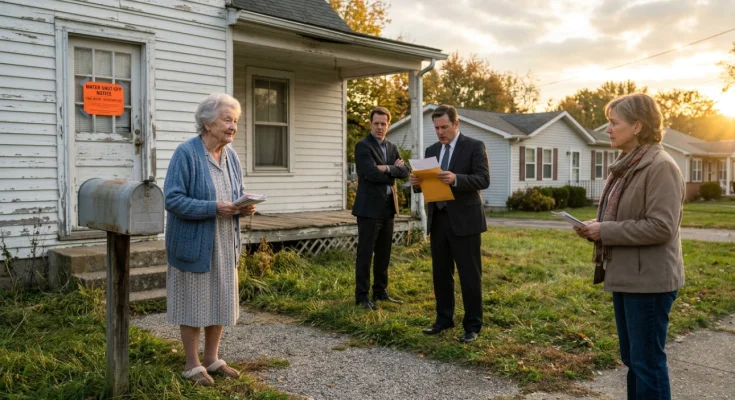
For six years I quietly paid the water bill for the house next door, and Ruth never knew. Her son found out the morning after the funeral, and he showed up at my door with a lawyer and a theory about what I’d wanted in return.
“Mrs. Doyle,” the lawyer said. “May we come in?”
“You may stand there,” I said.
I did not know the lawyer’s name, and I did not invite either of them across the threshold. Gerald stood slightly behind him, looking toward Ruth’s house instead of at me. The curtains were still drawn. A condolence arrangement sat near the front door, where someone had left it after the funeral.
Ruth was eighty-four when she died. She had lived in that house since Eisenhower. Her husband went in 2009, and after that the yard got long and the porch light stopped coming on.
I had known her as a neighbor, not as family. We exchanged mail when one of us brought in the wrong envelope, waved from the driveway, and spoke through the fence when there was something practical to discuss. She was private. So was I.
In the spring of 2019, I noticed a water shut-off notice on her door. It was bright orange and stuck there where anyone walking past could read it. I took it down before she saw me, called the county, and put the account on my card.
When Ruth asked about the notice later, I told her it had probably been left at the wrong house. She frowned at that but did not argue. I knew she would have refused if I told her I had paid it. Then she would have been embarrassed every time she saw me at the mailbox, and a woman that age has already lost enough without losing the ability to look her neighbor in the eye.
So for six years, twenty-nine dollars a month left my account. I did not keep a ledger on the refrigerator or calculate what it added up to. I paid it when the bill came and went on with the rest of my day.
That was the part Gerald had decided meant something else.
“Six years of payments,” he said. “Unexplained.”
His lawyer glanced at me. Gerald’s voice was controlled, but his face was not.
“To an elderly woman with early cognitive decline,” he continued. “And then a will that gets changed in 2021.”
“Ruth changed her will?” I said.
“Don’t.” His jaw tightened. “Please don’t do the surprised thing.”
“I am surprised.”
“You were around her constantly.”
“I was next door.”
“You know what I mean.”
I looked at him for a long moment. “Gerald, when did you last speak to your mother?”
“That’s not relevant.”
“June. You called on her birthday, and you were on the phone four minutes because I was sitting in the room with her and watched the clock.”
The lawyer shifted his weight. Gerald’s eyes moved toward the street.
Ruth had called me that morning because she could not get the television to work. By the time I arrived, Gerald was already on the phone. He asked whether she had received the birthday flowers, whether the insurance paperwork had come, and whether she was taking care of the house. Ruth answered each question politely.
When he said he had to go, she told him she loved him. He said he loved her too, then hung up before she could say anything else.
Afterward, she sat with the phone in her lap.
“He’s busy,” she said.
“I know.”
“He has a family.”
“I know that too.”
She nodded, as if she were defending him to both of us. I did not tell Gerald that part on the porch. I had no right to repeat everything Ruth said when she was trying to make his absence easier for herself.
“She fell in February,” I told him. “Did you know that? She was on the kitchen floor about forty minutes before I came over with the mail.”
“She never told me she fell.”
“No,” I said. “She didn’t.”
There was no answer to that. Gerald’s face did something complicated, a brief tightening around the mouth followed by a look I could not read. He was grieving, but grief did not make his suspicion harmless.
His lawyer recovered first.
“We’ll be filing for undue influence,” he said. “Any transfers of value from you to the decedent create a presumption, ”
“Twenty-nine dollars a month,” I said.
“It establishes a pattern of financial entanglement.”
“All right,” I said. “Then you’ll want the rest of it.”
The lawyer looked at Gerald. Gerald looked at me.
“What does that mean?” Gerald asked.
“I have something Ruth gave me in October.”
I went inside and brought back a manila envelope. I had kept it in a drawer for eleven days, exactly as she instructed. I had not opened it.
“What’s this?” Gerald asked.
“Ruth gave it to me in October. She asked me to hold it and not open it, and I didn’t. But she told me what was in it, in case you came.”
Gerald did not take the envelope.
“What did she tell you?”
“That it explained why she changed her will.”
His lawyer held out his hand. “I’ll take it.”
“She said if you ever showed up with a lawyer, I should give it to your lawyer and not to you.”
Gerald’s expression hardened. “You’re really going to do this?”
“I’m doing what she asked.”
CLICK HERE TO READ CONTINUE PART >> 2
You may also like
PART 2 >> My Neighbor Never Knew I Paid Her Bills—Until Her Son Arrived With a Lawyer.
I held the envelope past him. The lawyer took it and opened it right there on the porch,…
PART 3 >> My Neighbor Never Knew I Paid Her Bills—Until Her Son Arrived With a Lawyer.
“I didn’t ask for her house,” I said. “You paid her bills for years.” “I paid one bill.”…
PART 4 >> (THE END) My Neighbor Never Knew I Paid Her Bills—Until Her Son Arrived With a Lawyer.
The lawyer told me that in a phone call later, after Gerald had received the documents, he had…