
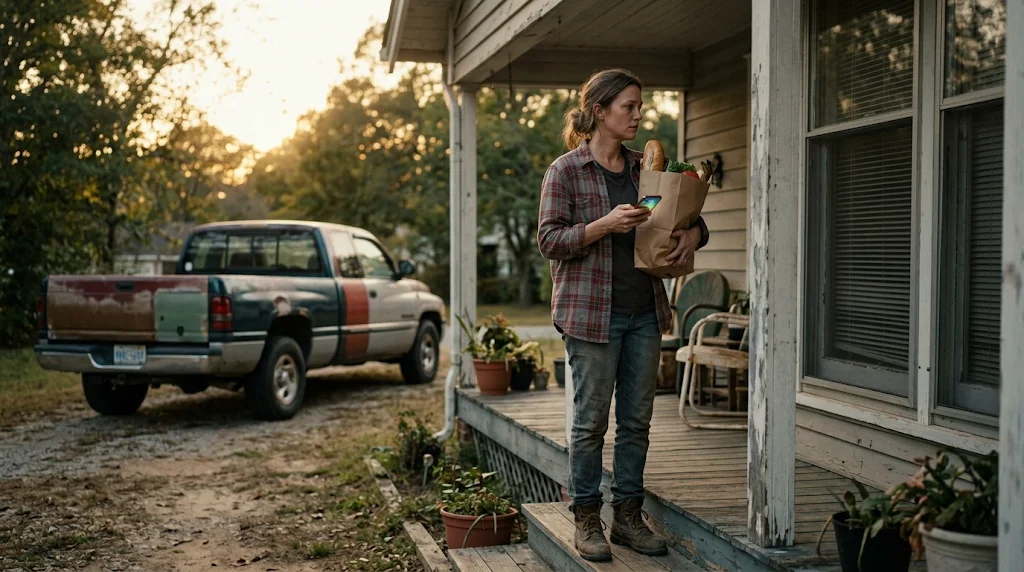
PART >> 4 (END) “Three days after I quietly sold my farm for $39 million, I stopped by my parents’ house with two bags of groceries and heard my sister telling them I still couldn’t support myself. Then my father asked how much money they had already given “for Fay,” and I froze on the porch
I believed she meant it. Belief did not erase caution. “Thank you.” Before ending the call, Diane revealed one final detail.
Sarah had ordered custom furniture using David’s credit. Nearly twenty-seven thousand dollars. The delivery company was charging storage fees. David knew nothing.
That afternoon, he requested a meeting. I chose Ellen’s office. Neutral walls felt safer. David arrived early.
He wore the same blue shirt Michael gave him during their final Christmas. He carried a thick envelope. “I brought records,” he said. Ellen sat beside me.
David did not object. He placed the envelope on the conference table. Inside were bank statements, credit-card bills, and messages. Sarah had emptied their emergency account.
She had opened two cards using David’s information. She had also scheduled an appointment with a notary. The forged power-of-attorney form was meant for that appointment. “How could the notary approve it?”
I asked. “She planned to bring someone else.” David’s voice barely carried. “Someone pretending to be you.”
Even Ellen looked stunned. “Who?” she asked. “Sarah’s former coworker.” “Did that person agree?” “She says Sarah described it as a harmless family document.”
Ellen wrote down the name. I looked at my son. “When did you learn this?” “Yesterday.” “And what did you do?” “I contacted the detective.” That mattered. It did not absolve him.
But it mattered. David folded his hands. “I moved out of the motel.” “Where are you staying?” “With Mark from work.” “Does Sarah know?” “No.” “Are you returning to her?” “I filed for separation.” I felt no triumph. A marriage collapsing is not a victory. Even a damaged marriage contains someone’s lost hope. “Why?” I asked. “Because she committed fraud.” “That is one reason.”
He stared at me. “Because I became someone I do not recognize.” “That is closer.”
He breathed unsteadily. “I kept choosing the easiest silence.” “Yes.” “When Sarah insulted you, I told myself she was under pressure.” “And when she ordered me out?” “I wanted you to surrender.” The honesty cut cleanly. “Why?” “Because disappointing you felt safer than confronting her.” Ellen lowered her pen. David’s eyes remained on mine. “You always forgave me.”
I understood then. His dependence was not accidental. My endless rescue had taught him that my love absorbed consequences. Sarah exploited that lesson.
But I had helped create it. “I did forgive you,” I said. “Before you changed.” “I know.” “I called that love.” “What was it?” “Sometimes, it was fear.” He looked confused. “I feared losing you.” My throat tightened. “So I accepted smaller wounds.” David began crying silently.
I let him. “I am sorry,” he whispered. “I believe you feel sorry.” “That is not forgiveness.” “No.” “Will you ever forgive me?” “I do not know.” He nodded.
For once, he did not demand comfort. “What can I do?” “Tell the complete truth.” “I will.” “Pay your own debts.” “I will.” “Find permanent housing.” “I already applied.” “And do not come home without an invitation.” His face twisted. But he answered correctly. “I understand.”
The investigation lasted four months. The former coworker cooperated. She produced messages showing Sarah’s instructions. Diane provided payment records.
The moving company supplied the false ownership declaration. David surrendered every message, including those embarrassing him. Sarah initially denied everything. Then she blamed David.
When evidence contradicted that, she blamed financial stress. Finally, she blamed me. According to her, my refusal to share wealth had forced desperate choices. The prosecutor did not agree.
The forged form, identity documents, and planned impersonation supported multiple charges. The court issued a no-contact order. Sarah repaid Diane through a formal agreement. The furniture was returned.
David remained responsible for part of the debt because he had ignored months of account notices. He did not complain. He sold the silver SUV. He moved into a modest one-bedroom apartment.
He began attending counseling. Once each month, he mailed me a letter. The first contained twelve pages. I read only two.
The second contained six. I read all six. By the fifth month, his letters became shorter. Not careless.
Clearer. He stopped explaining Sarah. He stopped describing himself as caught between two women. He wrote one sentence that stayed with me.
I was not trapped. I was choosing comfort over character. I placed that letter inside Michael’s desk. Autumn arrived quietly.
Leaves filled the gutters. The maples turned copper. One Saturday morning, I found David on the sidewalk. He carried work gloves and a folded ladder.
He did not approach the porch. “The gutter above your bedroom is pulling loose,” he said. “I noticed.” “May I repair it?”
I studied him. “Are you offering help or purchasing forgiveness?” His mouth opened. Then he considered the question. “Offering help.” “And if I say no?” “I go home.” “No anger?” “No.” “No wounded messages?” “No.” I opened the gate. “You may repair the gutter.” He worked outside for nearly two hours. He brought his own tools. He asked before using the outdoor electrical socket.
When he finished, he packed everything. He did not ask to enter the house. I carried two mugs outside. His expression softened. “Tea?” “On the porch.” We sat apart. The afternoon smelled of leaves and rain.
For a while, neither of us spoke. Then David glanced toward the front door. “I used to think having a key meant belonging.” “What do you think now?” “It means someone trusts you.” I wrapped both hands around my mug. “And belonging?”
He looked toward the geraniums. “Belonging means you respect what is not yours.” The answer sounded earned. Not finished.
But earned. “You may visit next Sunday,” I said. “For dinner?” “For one hour.”
His smile appeared cautiously. “What should I bring?” “Bread.” “I can do that.”
He arrived Sunday at precisely five. He knocked. That detail nearly undid me. I opened the door.
He carried fresh bread, not an overnight bag. During dinner, he asked about my garden. He washed his plate. At six, he stood to leave.
No sighing. No lingering. No request for a key. At the threshold, he turned toward me. “Thank you for letting me visit.” I nodded. “Goodnight, David.” “Goodnight, Mom.”
After he left, the house felt peaceful. Not empty. Peaceful. Those feelings had once seemed identical to me.
Now I knew better. Winter brought the court hearing. I had not planned to attend. Then Sarah requested a mediated statement.
Ellen advised me that I could decline. I almost did. But unfinished truth has its own gravity. So I entered a quiet conference room.
Sarah sat across the table. She looked smaller without perfect makeup and expensive clothes. David sat beside his attorney, not beside either of us. Sarah avoided my eyes.
The mediator reviewed the proposed resolution. Restitution. Probation. Fraud counseling.
A permanent protective order. No access to my home, accounts, records, or identity. Sarah would admit the forged document and attempted impersonation. When the mediator finished, Sarah finally looked at me. “I hope you are satisfied.” Her bitterness remained alive. I felt strangely calm. “This was never about satisfaction.” “You destroyed my marriage.” “No.” “You turned David against me.” “No.” “You called the police.” “Yes.” Her eyes narrowed. “You could have handled it privately.” “You tried to steal privately.” The mediator shifted. Sarah leaned forward. “You always hated me.” “I distrusted your entitlement.” “You never welcomed me.” “I gave you shelter.” “For three days.” “For as long as you respected my home.” “You put my belongings outside.” “I packed them carefully.” “You humiliated me.” “You lied to movers, police, relatives, and your husband.” Her jaw trembled. “You think you won.” “This was not a contest.”
I held her gaze. “It was my home.” No one spoke. The heating vent whispered overhead.
Then Sarah’s expression cracked. Not into remorse. Into exhaustion. “I thought if we moved in,” she said, “everything would finally stabilize.” “By removing me?” “By making decisions.” “For everyone except yourself.” She looked toward David.
He remained still. “I was scared,” she whispered. For the first time, I believed her. Fear explained her choices.
It did not excuse them. “So was I,” I said. “The difference is I did not steal your life.”
Sarah lowered her eyes. She signed the agreement. David signed his statement. I signed nothing except acknowledgment of receipt.
Outside the courthouse, David waited near the steps. Sarah left through another exit. Snow began falling lightly. “Is it over?”
he asked. “The legal part may be.” “And us?” I looked at him. “We are not a legal problem.” His eyes filled. “What are we?” “A relationship under repair.”
He exhaled slowly. “I can live with that.” “You will have to.” He almost smiled.
Then he became serious. “Dad would be ashamed of me.” I considered that. “Your father would be disappointed.” “That feels worse.” “It should.” He looked down. “But he would also expect change.”
David nodded. “So do I.” Spring arrived. The geranium survived indoors. New leaves appeared along the damaged stem.
I repainted the guest room. Not for David. Not for Sarah. For myself.
I chose pale green walls and linen curtains. Michael’s reading chair remained beside my bedroom window. One afternoon, I moved it downstairs. The leather creaked as David helped me carefully.
He waited for directions. “Near the library window,” I said. We set it there. When he lifted one cushion, an envelope slipped underneath.
The paper was yellowed. Michael’s handwriting crossed the front. For Kimberly. My knees weakened.
I sat immediately. David placed the envelope in my hand. “Did you know about this?” “No.”
The seal opened easily. Inside was one page. Michael had written it during his final year. His words blurred before I finished reading.
David knelt beside me. “What does it say?” I handed him the page. He read silently.
Michael had written that houses remember voices. They remember slammed doors, midnight laughter, illness, forgiveness, and every ordinary breakfast. But walls cannot decide who deserves shelter. That choice belongs to the living.
His final paragraph was only three sentences. Do not shrink for anyone. Keep the chair near sunlight. Make them knock.
David covered his mouth. A sob escaped him. I reached for his hand. It was the first time I had touched him since the morning he demanded my bedroom. “I am sorry,” he said. “I know.” “No explanations.” “Good.” “No asking you to forget it.” “Good.” “I just need you to know I am sorry.” “I do.”
We sat beside each other. Sunlight warmed Michael’s empty chair. For several minutes, grief occupied the room without controlling it. Then David folded the letter.
He returned it gently. “Dad knew you.” “Yes.” “He knew me too.” “Perhaps.” David looked toward the door. “I should go.” “You could stay for supper.”
He stared at me. “Are you sure?” “Yes.” His shoulders loosened. “What can I do?” “Set the table.” He did. Over the following year, trust returned in small measures.
David never received another house key. He stopped expecting one. He built savings again. He paid down the debt.
He completed counseling without treating it as a performance. Eventually, he rented a brighter apartment near his workplace. I visited once. He had one couch, two mismatched lamps, and no walk-in closet.
He seemed proud. At the door, he handed me tea. “I bought the kind you like.” “I noticed.”
He looked nervous. “Do you feel welcome?” “Yes.” That answer mattered to him.
Before I left, I noticed his old baseball glove on a bookshelf. The cracked seam had been repaired. “Did you fix that?” “I learned how.”
I smiled. “So you did.” Our family changed too. Linda stopped carrying gossip between relatives.
Diane entered counseling with Sarah after probation began. She never asked me to reconcile with her daughter. She only sent one letter. It contained no excuses.
I filed it away without answering. Forgiveness, I learned, does not require renewed access. Sometimes it means releasing the poison while keeping the gate closed. The following summer, I hosted a small dinner.
Linda came early. David brought bread. Officer Monroe stopped briefly, off duty and smiling. Ellen arrived with flowers.
We ate beneath strings of porch lights. No one claimed my chair. No one instructed me where to sleep. No one treated kindness as surrendered ownership.
When darkness settled, David collected the plates. I watched him pause beside the geraniums. The damaged plant had become the fullest one. “You saved it,” he said. “It still had good roots.” He looked at me carefully. I knew what he heard. Perhaps I intended it.
Perhaps I did not. When everyone left, David hugged me gently. Then he stepped away first. “Dinner next month?” “We will see.” He smiled. “That means maybe.” “It means we will see.” “Goodnight, Mom.” “Goodnight, David.” He walked down the porch steps. At the gate, he turned back.
The house glowed behind me. Michael’s chair rested near the library window. The brass desk key remained safely inside. My documents were secure.
My bedroom was mine. More importantly, my choices were mine. David raised one hand. I raised mine.
Then he drove home. I locked the door afterward. Not angrily. Not fearfully.
Simply because darkness had fallen. I made a cup of tea. The refrigerator hummed softly. Outside, leaves stirred beneath the porch light.
I sat in Michael’s chair and opened the window. Warm night air entered. The house held laughter again. It also held boundaries.
Both could live together. That was the truth I had nearly learned too late. Love should make room for another person. It should never demand that you erase yourself.
Three days after David and Sarah entered my home, I placed their belongings outside. A year later, I understood what else I had moved that morning. Fear. Guilt.
Habit. The belief that motherhood required endless surrender. I had carried those burdens far longer than any suitcase. Now they were gone.
CLICK HERE TO READ OTHER STORY
You may also like
PART >> 2 “Three days after I quietly sold my farm for $39 million, I stopped by my parents’ house with two bags of groceries and heard my sister telling them I still couldn’t support myself. Then my father asked how much money they had already given “for Fay,” and I froze on the porch
“Move your things,” Sarah said, lifting her iced latte as casually as if she were asking me to…
PART >> 3 “Three days after I quietly sold my farm for $39 million, I stopped by my parents’ house with two bags of groceries and heard my sister telling them I still couldn’t support myself. Then my father asked how much money they had already given “for Fay,” and I froze on the porch
Officer Monroe remained nearby. “You handled that calmly,” she said. “I was not calm.” “No,” she replied. “But…

PART 1 – The Bass Boat Sale That Made My Former Husband Learn What Declined Really Meant
The salesman held the card between two fingers. “Sir, I’m sorry. It’s been declined.” Faron stared at him.…
One Comment on “PART >> 4 (END) “Three days after I quietly sold my farm for $39 million, I stopped by my parents’ house with two bags of groceries and heard my sister telling them I still couldn’t support myself. Then my father asked how much money they had already given “for Fay,” and I froze on the porch”