
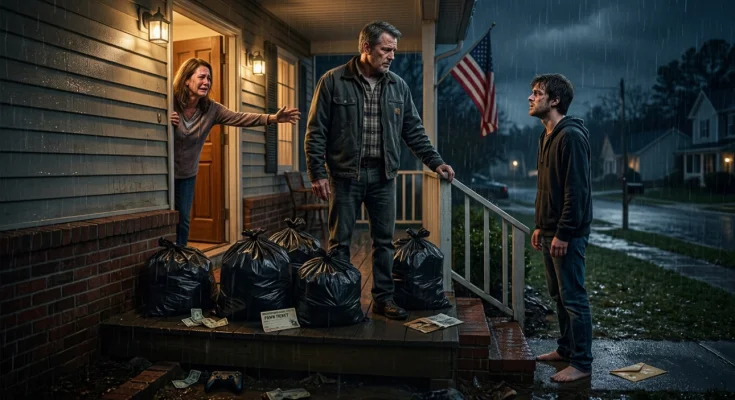
PART 8- I packed all of my 22-year-old son’s clothes into black trash bags and threw him out onto the street
Six months after Matt drove away from Raymond’s shop, the quiet routine of our lives had settled into something steady and real.
The winter cold had yielded to a bright spring. On a sunny Saturday afternoon, the doorbell rang at two o’clock. It wasn’t the frantic, uncertain buzz of the past. It was a firm, rhythmic double-tap.
I opened the door to find Daniel wearing a clean button-down shirt, dark jeans, and leather boots. Standing beside him, holding his hand, was a woman with a warm smile and a camera strap slung over her shoulder.
“Dad,” Daniel said, his voice grounded and relaxed. “This is Maya. She does photography for the local newspaper and rents the apartment on the third floor across from mine.”
Teresa came rushing out of the kitchen, wiping her hands on a dish towel, her face instantly lighting up. “Come in, come in! I just put the coffee on.”
As we sat around the living room table, Maya talked about her work covering community events and how she and Daniel had met when he helped her carry three heavy boxes of camera gear up three flights of stairs.
“He told me all about Uncle Raymond’s shop,” Maya said, looking at Daniel with genuine respect. “And how hard he’s been working to finish his trade certificate.”
I watched Daniel carefully. There was no fidgeting, no darting eyes, no nervous checking of his phone for betting notifications. When Maya complimented his work ethic, he didn’t boast or brag. He simply nodded and said, “It took me a while to find my footing, but Raymond’s a good teacher.”
Later, while Teresa showed Maya some old family photo albums in the living room, Daniel walked into the kitchen where I was rinsing the coffee cups.
He leaned against the counter, setting down an envelope.
“What’s this?” I asked, looking down at it.
“That’s two hundred dollars,” Daniel said quietly. “That clears the last of what I owed you for the laptop.”
I looked at the envelope, then up at my son. For two years, I had believed that money was the root of every lie in our home. But looking at that envelope, I realized it wasn’t about the money at all. It was about accountability.
“You don’t have to take it right now if you want to inspect it,” Daniel added, a faint, good-natured smirk touching his lips.
“I don’t need to count it,” I said, picking up the envelope and putting it into my pocket. “Thank you, Daniel.”
He looked toward the living room, where Maya and Teresa were laughing together over a photo of Daniel at age six.
“Dad?” he asked softly.
“Yeah?”
“Thanks for not making it easy for me,” he said, his voice dropping an octave. “I know how much it hurt Mom. I know how much it hurt you. But if you had let me back in that night… I would have brought Matt right into this kitchen.”
I set the dish towel down, walked over, and put my hand on his shoulder. His frame felt solid—built by sweat, discipline, and honest days.
“You did the heavy lifting, Daniel,” I told him. “We just held the line.”
When they left that evening, Teresa stood beside me at the window, watching Daniel and Maya walk down the sidewalk toward the bus stop, hand in hand, chatting in the golden afternoon light.
Teresa wrapped her arm through mine, resting her head against my shoulder.
“He’s going to be okay, isn’t he, Arthur?” she whispered.
I looked out at the street—the same street where I had once left my son sitting on his trash bags in the damp night air.
“He’s already okay, Teresa,” I said, pulling her close. “He’s carrying his own weight now.”
And as the bus pulled up to the corner and Daniel helped Maya step aboard, I knew that our home wasn’t just safe—it was finally, truly, at peace.
CONTINUE READ >>>> PART 9
You may also like
Part 2- I packed all of my 22-year-old son’s clothes into black trash bags and threw him out onto the street
Part 2 Teresa lunged at me to grab the phone. With sheer desperation. “Arthur, please, don’t open it.”…
Part 3 – I packed all of my 22-year-old son’s clothes into black trash bags and threw him out onto the street
The night air at Uncle Raymond’s auto shop smelled like stale coffee, motor oil, and rusted iron. Inside…
PART 4 – I packed all of my 22-year-old son’s clothes into black trash bags and threw him out onto the street
Daniel walked into the kitchen slowly, his worn socks making a quiet dragging sound against the linoleum. He…