
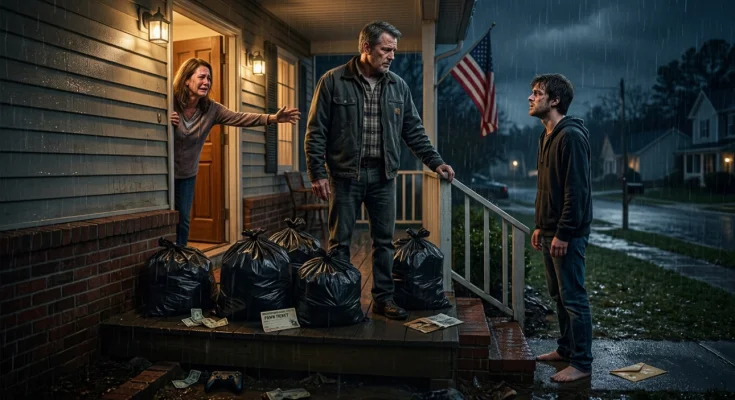
PART 7- I packed all of my 22-year-old son’s clothes into black trash bags and threw him out onto the street
The next morning at Uncle Raymond’s auto shop, the air was thick with the scent of motor oil, hot exhaust, and cheap coffee.
Daniel stood over the open hood of a rusted ’08 sedan, grease smudged across his forehead, a wrench gripped firmly in his right hand. It had been four months since he started his apprenticeship under Raymond. His hands were calloused, his back ached every evening, but for the first time in his life, he was earning a clean living.
Then, the heavy garage door clicked and began to roll upward.
A sleek, black European sedan pulled into the bay, its engine idling with a low, expensive hum. The driver’s side window rolled down, and a guy in a tailored leather jacket leaned out.
Matt.
Daniel froze, the wrench lowering in his hand.
“Look at you, man,” Matt said, stepping out of the car with that same easy, arrogant smirk he used to pull when they were planning their next score. “Working in the grease. I almost didn’t recognize you without a screen in your face.”
Daniel took a slow breath, remembering the cold rain outside the 7-Eleven, the trash bags, and the way Matt had walked away the second the money ran out. “What do you want, Matt?”
“Just checking in on my brother,” Matt said, strolling up to the front of the sedan and tapping his knuckles on the fender. “Listen, I got a line on something big. Private poker game up in Westchester. High rollers, easy marks. I just need a guy with a clean ID to rent the room under his name. Two hundred bucks cash in your pocket for twenty minutes of work.”
Daniel looked at Matt. For a fraction of a second, the old habit—the quick high, the easy out, the illusion of quick cash—flickered in his chest.
Then he looked past Matt toward the glass office window.
Inside, Uncle Raymond was writing down inventory on a clipboard. He wasn’t watching Daniel like a hawk. He didn’t have his phone out to spy on him. He trusted him to handle the front bay.
Daniel set the wrench down on the metal workbench with a loud, deliberate clank.
“I’m busy, Matt,” Daniel said, his voice flat and completely devoid of emotion. “Get your car out of the bay.”
Matt’s smirk faded, replaced by an ugly, defensive glare. “Come on, Daniel. Don’t act like you’re better than me. You’re working for pocket change while your dad treats you like a servant. I know you still owe payday loans.”
“I do owe them,” Daniel said, stepping up until he was looking straight into Matt’s eyes. “And I’m paying them back ten dollars a week with money I actually earned. Now get out before I call Raymond out here to clear the bay himself.”
Matt stared at him, realized there was no weak spot left to exploit, and spat on the garage floor. “You’re an idiot, Daniel.”
“Maybe,” Daniel said, picking his wrench back up. “But I’m not your friend anymore.”
Matt got back into his car, slammed the door, and reversed out of the driveway, tires screeching against the asphalt.
Inside the office, Raymond set his clipboard down. He didn’t say a word about Matt, and he didn’t offer a dramatic speech. He just opened the office door, tossed Daniel a cold bottle of water, and said, “Timing belt on that sedan needs replacing before three o’clock, kid.”
Daniel caught the water, twisted off the cap, and took a long drink.
“On it, Ray,” he said.
That Sunday evening, Daniel came over to our apartment for dinner.
He didn’t bring trash bags. He didn’t ask for a loan. He brought a box of fresh pastries from the bakery near his apartment, bought with his own tips.
As we sat around the table, the television hummed quietly in the background—not a battlefield anymore, just background noise. Teresa smiled as she poured coffee, her mother’s new gold-plated earrings glinting softly in the warm light of the dining room lamp.
“How was work this week?” I asked Daniel, passing him the serving platter.
Daniel took a piece of chicken, looked at me, and offered a calm, grounded smile.
“Hard, Dad,” he said simply. “It was really hard. But it was a good week.”
Teresa reached over under the table and squeezed my hand. I squeezed back.
The door was still there—solid, quiet, and strong. But it was no longer a barrier kept shut in desperation. It was a doorway where a family stood together, finally whole, finally safe, and finally free.
CONTINUE READ >>>> PART 8
You may also like
Part 2- I packed all of my 22-year-old son’s clothes into black trash bags and threw him out onto the street
Part 2 Teresa lunged at me to grab the phone. With sheer desperation. “Arthur, please, don’t open it.”…
Part 3 – I packed all of my 22-year-old son’s clothes into black trash bags and threw him out onto the street
The night air at Uncle Raymond’s auto shop smelled like stale coffee, motor oil, and rusted iron. Inside…
PART 4 – I packed all of my 22-year-old son’s clothes into black trash bags and threw him out onto the street
Daniel walked into the kitchen slowly, his worn socks making a quiet dragging sound against the linoleum. He…